Band 5.0 IELTS Writing Task 1 Model Answer
Overall Band Score: 5.0 · Cambridge IELTS 13 · 2026-11-18
IELTS Writing Task 1 question
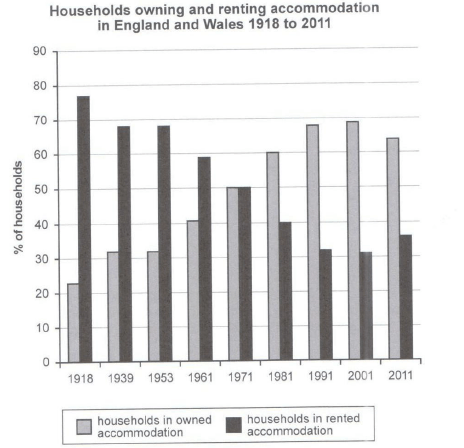
The chart below shows the percentage of households in owned and rented accommodation in England and Wales between 1918 and 2011.
Summarize the information by selecting and reporting the main features and make comparisons where relevant.
Student answer (Band 5.0)
The bar chart shows the percentage of houses accomodation in owned and rented in england and wales from the period 1918 to 2011.
Overall, it is clear that rented accomodation took highest percentage while owned accomodation shows lowest percentage over the given period of time .
To begin with , in 1918 rented accomodation took 78 percent which further starts declined in other years and reach to 50 percent in 1971 after that in 2001 only 31 percent of households lived in rented houses in uk and wales . In 2011 the percentage starts increase to 35 .
Moving further ,owned accomodation is 22 percentage in 1918 . In 1939 owned houses shows continoued rose to69 percent in 2001and then dropped to62 percent in2011.
AI examiner evaluation
| Criterion | Band |
|---|---|
| Task Achievement / Task Response | 4.5 |
| Coherence and Cohesion | 5.5 |
| Lexical Resource | 5.0 |
| Grammatical Range and Accuracy | 5.0 |
| Overall | 5.0 |
Task Achievement / Task Response: Band 4.5
You identify the two categories and the broad shift from renting towards ownership, and you include several relevant figures, such as renting at about 50% in 1971 and 31% in 2001. However, the overview is inaccurate: renting did not remain the highest share throughout, since the figures were equal in 1971 and ownership was higher thereafter until 2011. The ownership account also misreads the data: it was about 32% in 1939, not 69%, and peaked at about 69% in 2001 before falling to 64%. The response is under the required 150 words, which limits how fully you can select and report the main features. Add the missing turning points and make the overall comparison precise.
Coherence and Cohesion: Band 5.5
The response has a basic, recognisable structure: an introduction, an overview, and separate paragraphs beginning with “To begin with” and “Moving further.” This helps the reader distinguish the two accommodation types. However, progression is limited because the figures are mostly listed rather than organised into clear phases or direct comparisons. The overview also conflicts with the later data, and “after that” does not make clear which years are being compared. Some linking phrases feel mechanical, while spacing and punctuation around them are inconsistent. Group the early years, the 1971 crossover, and the later ownership peak into a logical sequence, and use concise comparisons to connect the two trends.
Lexical Resource: Band 5.0
You use relevant topic vocabulary, including “percentage,” “households,” “owned accommodation,” and “rented accommodation,” so the subject is generally clear. However, the range is limited and several word choices or collocations are inaccurate, such as “houses accomodation,” “took highest percentage,” and “starts declined.” Repetition of “accommodation” and “percentage” also makes the report less precise. Spelling errors such as “accomodation” and “continoued” are noticeable, and “in uk and wales” is not an accurate way to name the places in the chart. Use standard chart language such as “accounted for,” “fell,” “rose,” and “share of households,” while checking spelling and place names.
Grammatical Range and Accuracy: Band 5.0
You attempt both simple statements and longer sentences, including a sequence linked with “after that,” but the range is limited and errors recur. For example, “rented accomodation took 78 percent which further starts declined” has an unclear clause structure and an incorrect verb form; “owned houses shows continoued rose” also has problems with agreement and verb construction. Missing or misplaced commas, inconsistent spacing, and sentence-final punctuation further affect accuracy. Some meaning can still be understood, but these errors make the trends harder to follow. Practise accurate past-tense reporting (“renting fell,” “ownership rose”) and build longer sentences around one clear comparison at a time.
See this exact question answered at other band scores. The same prompt compared across bands.
Browse more IELTS Writing model answers or get your own writing scored by the same AI examiner.