Band 5.5 IELTS Writing Task 1 Model Answer
Overall Band Score: 5.5 · Cambridge IELTS 13 · 2026-11-18
IELTS Writing Task 1 question
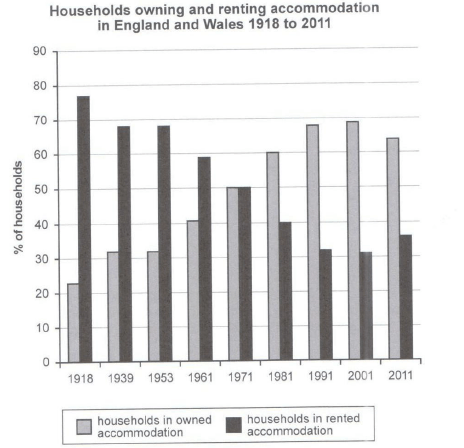
The chart below shows the percentage of households in owned and rented accommodation in England and Wales between 1918 and 2011.
Summarize the information by selecting and reporting the main features and make comparisons where relevant.
Student answer (Band 5.5)
The bar graph chart below shows the percentage of households in owned and rented accommodation in England and Wales between 1918 and 2011.
Overall, 78 % of the households in had an rented accommodation in 1918, which is also the highest of all amongst other years, whereas, approximately, only 22% of the individuals lived in owned accomodation the same year, being the lowest compared with other years.
On the hand, the households in rented accomodation was at its peak during 1918, however, the percentage fell to 69% during the year 1939 and 1953 respectively. Furthermore, in the year 1961, the percentage fell down to 59% and kept declining and reached 31% by 2001. Moreover, there was seen a rise in percentage during 2011 by 4%.
On the other hand, households in owned accomodation were only at 22% in the year 1918. Gradually individuals shifted to investing in properties and number rose to 31% both the years in 1939 and 1953. The number further rose to 41%, 50%, 60% & 79% in the years 1961, 1971, 1981 and 1991 respectively. In 2011, it fell down to approximately 64%.
AI examiner evaluation
| Criterion | Band |
|---|---|
| Task Achievement / Task Response | 6.0 |
| Coherence and Cohesion | 5.5 |
| Lexical Resource | 5.5 |
| Grammatical Range and Accuracy | 5.5 |
| Overall | 5.5 |
Task Achievement / Task Response: Band 6.0
You cover both ownership and renting and identify the broad reversal: renting declines from its high in 1918, while ownership generally rises before falling in 2011. Several figures are close to the chart, including 59% rented in 1961 and 64% owned in 2011. However, the overview is not fully accurate: ownership peaks at about 69% in 2001, not 79% in 1991, and the 2011 rise in renting is about five percentage points, rather than simply “by 4%.” The claim that people shifted to investing in properties also adds an explanation the chart does not provide. Select the main turning points accurately and describe the overall pattern without inferring causes.
Coherence and Cohesion: Band 5.5
The response has a recognisable structure, with an opening, an overview and separate paragraphs for rented and owned accommodation. This makes the two series easy to distinguish. However, progression is weakened by repetition: the overview already gives the 1918 figures, which are then repeated at the start of both detail paragraphs. Linking phrases such as “On the hand,” “On the other hand,” and “Moreover” are sometimes awkward or do not clearly show the relationship between points. The final paragraph also lists several years and figures in one sentence, making the trend harder to follow. Organise the details into clear stages and use transitions that express contrast or sequence precisely.
Lexical Resource: Band 5.5
You use relevant chart vocabulary, including “percentage,” “declining,” “rose,” and “peak,” so the main trends are generally understandable. However, some word choices and collocations are inaccurate or repetitive. “Individuals lived in owned accommodation” is less suitable than describing households, and “the number rose” is imprecise when the chart reports percentages. “Fell down” is also less natural in this context than “fell” or “declined.” Spelling errors in “accomodation” recur, and phrases such as “highest of all amongst other years” are unnecessarily wordy. Aim for precise terms such as “proportion of households” and vary trend verbs while checking spelling and collocation.
Grammatical Range and Accuracy: Band 5.5
You attempt a mix of simple and more complex sentences, including a contrast with “whereas” and clauses introduced by “however.” The main comparisons remain understandable, but some grammatical errors recur. For example, “the households in rented accommodation was” has subject–verb disagreement, while “the households in had an rented accommodation” contains problems with sentence structure and articles. “On the hand” is also an incomplete expression, and the sentence beginning “The number further rose to…” needs clearer punctuation and a more controlled list. Practise checking agreement, articles and complete sentence patterns, especially when combining several figures. More accurate control of these structures would make the comparisons easier to read.
See this exact question answered at other band scores. The same prompt compared across bands.
Browse more IELTS Writing model answers or get your own writing scored by the same AI examiner.