Band 6.5 IELTS Writing Task 1 Model Answer
Overall Band Score: 6.5 · Cambridge IELTS 13 · 2026-11-18
IELTS Writing Task 1 question
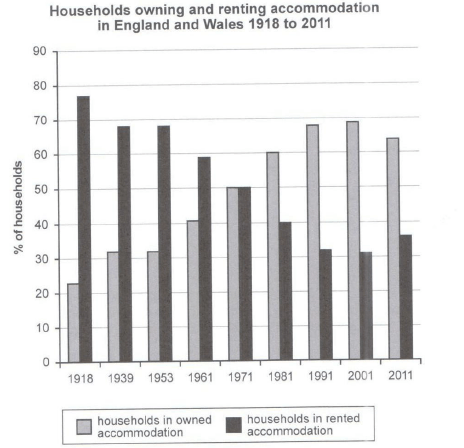
The chart below shows the percentage of households in owned and rented accommodation in England and Wales between 1918 and 2011.
Summarize the information by selecting and reporting the main features and make comparisons where relevant.
Student answer (Band 6.5)
The bar chart compares the proportion of households owning and renting accommodation in England and Wales between the years 1918 and 2011.
Overall, it is clearly that rented accommodation was the largest proportion of households and it decreased over the period, However, households in owned accommodation show another trend and it increased throughout the period, at the end of the period owned accommandation became the most popular in England and Wales.
In terms of households in rented accommandation, it recorded the highest proportion at nearly 78% at the beginning of the period, this figure show a small decreased until remained stable at 1939 and 1953 at approximately 68% before falling sharply to around 31% by 2001, then rose in 2011 reaching 35%.
On the other hand, owned accommandation show another trend, it recorded the lowest proportion in 1918 with 22% before rosing to the next years in 1939 and 1953 which remained stable to around 32%. This figure increased to a peak of just over 77% in 2001 before dropping slightly to approximately 63% by the end of the period.
AI examiner evaluation
| Criterion | Band |
|---|---|
| Task Achievement / Task Response | 6.5 |
| Coherence and Cohesion | 7.0 |
| Lexical Resource | 6.0 |
| Grammatical Range and Accuracy | 5.5 |
| Overall | 6.5 |
Task Achievement / Task Response: Band 6.5
You identify the chart’s subject and give an overview of the broad shift from renting to ownership, including the point at which the figures meet in 1971. Most reported values are close to the chart. However, the overview says ownership increased “throughout,” although it fell from 69% in 2001 to 64% in 2011; the later description also incorrectly gives ownership a peak of over 77%, apparently confusing it with the rented figure in 1918. These errors affect an important trend and endpoint. The response covers the main series and several stages, but the overview and ownership details need more accurate selection and reporting to make the account consistently clear and complete.
Coherence and Cohesion: Band 7.0
The response is organised into an introduction, an overview and two body paragraphs, with renting and ownership discussed separately. This gives the reader a clear overall progression, and phrases such as “On the other hand” help signal the contrast between the series. The chronological sequencing within each body paragraph is also generally easy to follow. Some links between clauses are less controlled: for example, the overview joins several contrasting points in one sentence, and the rented paragraph uses a comma where a full stop or conjunction would make the relationship clearer. More precise sentence boundaries and a less crowded overview would make the cohesion smoother, while retaining the effective paragraph structure.
Lexical Resource: Band 6.0
You use an adequate range of chart-related vocabulary, including “proportion,” “remained stable,” “falling sharply,” “peak” and “dropping slightly.” These choices help describe changes and comparisons, although some wording is imprecise or repetitive: “recorded” appears several times, and “show another trend” does not specify the trend clearly. There are also spelling errors in “accommandation” and “rosing,” and “small decreased” is an inaccurate word form. Such slips do not prevent understanding, but they limit precision and control. Use standard spellings and more varied, natural collocations for describing rises, falls and stability.
Grammatical Range and Accuracy: Band 5.5
You attempt both simple and more complex sentence forms, including clauses with “before” and “until,” and the main meaning is usually understandable. However, some sentences contain errors in clause structure, agreement and punctuation. For example, “it is clearly that” should be “it is clear that,” while “this figure show” needs subject–verb agreement. In “it recorded the highest proportion …, this figure show,” a comma joins two independent clauses; separate them or use a suitable conjunction. The overview also shifts awkwardly between “was,” “decreased” and “show.” Greater control of sentence boundaries, verb forms and agreement would make the varied structures more accurate and easier to read.
See this exact question answered at other band scores. The same prompt compared across bands.
Browse more IELTS Writing model answers or get your own writing scored by the same AI examiner.