Band 6.0 IELTS Writing Task 1 Model Answer
Overall Band Score: 6.0 · Cambridge IELTS 13 · 2026-11-19
IELTS Writing Task 1 question
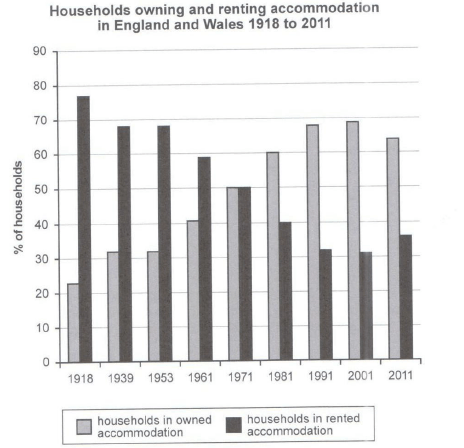
The chart below shows the percentage of households in owned and rented accommodation in England and Wales between 1918 and 2011.
Summarize the information by selecting and reporting the main features and make comparisons where relevant.
Student answer (Band 6.0)
The number of people owning an accommodation and the number of people renting an accommodation through the years 1918 to 2011 is shown in the chart.
Firstly the percentage of people renting an accommodation was dominant through the years 1918 to 1961. However there was a gradual increase in people owning a house alongside. The chart clearly shows that there was no apparent difference between the two forms of accommodation during the year 1971. It had a percentage of 50%.
On the other hand, after 1971, the percentage of households that were rented starting to decrease whereas the people owning a house starting to reach a higher percent. This form had a steady growth till 2001 and then slowed down in 2011 where renting became back in trend.
The highest percentage of people renting a house was in 1918 and the lowest was in 2001. With this, the highest percentage of people owning a house was in the year 2001 whereas the lowest was in 1918. This states a clear pattern between the two as shown in the chart.
The percentage of households are more inclined to be owned rather then to be rented in the recent years, in regards to the chart.
AI examiner evaluation
| Criterion | Band |
|---|---|
| Task Achievement / Task Response | 6.5 |
| Coherence and Cohesion | 6.5 |
| Lexical Resource | 6.0 |
| Grammatical Range and Accuracy | 5.5 |
| Overall | 6.0 |
Task Achievement / Task Response: Band 6.5
You identify the main pattern accurately: renting is more common at the start, the two categories meet at 50% in 1971, and ownership becomes more prevalent later. Your comparisons of the highest and lowest points are also correct. This gives the report a relevant overview and covers the key changes. However, some details are less fully reported: for example, ownership rises from 60% in 1981 to 68% in 1991 and peaks at 69% in 2001 before falling to 64% in 2011, while renting follows the reverse pattern. The phrase “renting became back in trend” is also unclear about the modest rebound to 36%. More precise figures and a clearer account of the final reversal would make the summary more complete.
Coherence and Cohesion: Band 6.5
The response is arranged in a generally logical sequence, moving from the early period to the crossover, then the later trend and the extremes. Paragraph breaks help separate these stages, and linking phrases such as “However” and “On the other hand” make the comparisons visible. This is a coherent overall structure. At times, though, the links feel mechanical or the reference is unclear: “This form” does not clearly identify ownership or renting, and “With this” does not establish a precise connection between the two extremes. The final sentence repeats the general conclusion rather than adding a distinct point. Use clearer references and connect each paragraph directly to the trend it describes to make progression smoother.
Lexical Resource: Band 6.0
You use enough vocabulary to describe the chart’s main movements, including “gradual increase,” “steady growth,” “highest percentage” and “lowest.” These choices communicate the broad trends, and the meaning is generally clear. However, some wording is imprecise or unnatural for describing household data. “People owning an accommodation” and “people renting a house” do not match the chart’s measure of households, while “renting became back in trend” is an awkward way to describe the increase after 2001. Repetition of “percentage” and “people” also limits flexibility. Choose precise terms such as “households,” “ownership rate” and “rented accommodation,” and use verbs such as “rose,” “fell” and “rebounded” to describe changes accurately.
Grammatical Range and Accuracy: Band 5.5
You attempt a mixture of simple and more complex sentences, including a contrast with “whereas” and a time clause beginning “after 1971.” Most of the intended meaning can be understood, but some errors in verb forms and sentence construction remain. For example, “the percentage of households that were rented starting to decrease” needs a complete and correctly formed verb phrase, such as “the percentage of households in rented accommodation started to decrease.” Similarly, “people owning a house starting to reach” lacks a finite verb, and “The percentage of households are” has subject–verb disagreement. There are also awkward article and number patterns in “an accommodation.” Check that each clause has a correctly conjugated verb and that the verb agrees with its subject.
See this exact question answered at other band scores. The same prompt compared across bands.
Browse more IELTS Writing model answers or get your own writing scored by the same AI examiner.