Band 5.5 IELTS Writing Task 1 Model Answer
Overall Band Score: 5.5 · Cambridge IELTS 13 · 2026-11-19
IELTS Writing Task 1 question
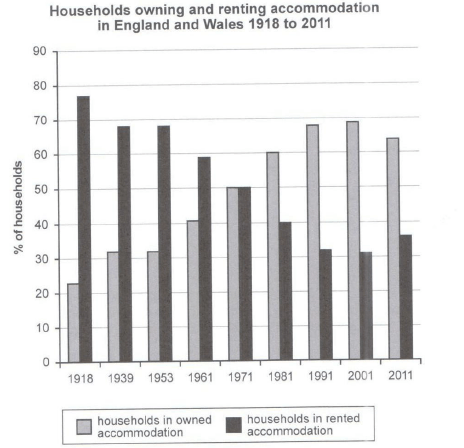
The chart below shows the percentage of households in owned and rented accommodation in England and Wales between 1918 and 2011.
Summarize the information by selecting and reporting the main features and make comparisons where relevant.
Student answer (Band 5.5)
The bar chart depicts the percentage of who owning the households and renting accoummodation in England and Wales between 1918 and 2011.
Overall, owner-occupied households rose sharply before a slight decline in 2011. Rental accommdation was decreased dramatically till the year of 2001 whereas, it increase moderately. The notable point is that both accommodation category recorded the equal ratio that is in 1971.
owner-occupied residences was at its lowest in 1918 that is about 23% which increased to 30% in 1939 persisted same in 1953 furthermore it reached nearly 40% in 1961. In contrast, resides in rental accommodation was at peak of it in 1918, with approximately 78%. Thereafter it reduce close to 68% which stayed same in 1953 then decline to 59% in 1961.
In 1971, owned households and rented accommodation amounted to 50% in 1971 which was the notable point too.
Turning at 1981 where owned occupied was 60% while rental house had 40% respectively. In 1991 and 2001 the ratio of owned households were almost same which is around 79%, moreover housholds in rented accommodation was roughly 31% in the same years. after 2001, living in owned house reduce to 64% and rented house rise to 36%.
AI examiner evaluation
| Criterion | Band |
|---|---|
| Task Achievement / Task Response | 6.0 |
| Coherence and Cohesion | 6.0 |
| Lexical Resource | 5.5 |
| Grammatical Range and Accuracy | 5.0 |
| Overall | 5.5 |
Task Achievement / Task Response: Band 6.0
You cover the full period and identify the main overall pattern: ownership generally increased while renting declined, with both at 50% in 1971 and a reversal in direction by 2011. Most figures are grounded in the chart, including the early values and the final 64%/36% split. However, the statement that ownership was “around 79%” in 1991 and 2001 is inaccurate; the figures are about 68% and 69%. The overview also says renting decreased “dramatically,” which is less precise than describing its steady decline before the late-period rise. To strengthen the report, correct the mid-to-late figures and make the overview more exact about the peak and subsequent fall in ownership.
Coherence and Cohesion: Band 6.0
The response has a clear overall structure: an introduction, an overview, and paragraphs that report the earlier and later years. The chronological sequence makes the main changes easy to follow, and contrasts such as “In contrast” help distinguish the two categories. Some links are awkward or repetitive, however. The 1971 equality is mentioned in both the overview and the body, and “In 1971” is repeated within the same sentence. The transition “Turning at 1981” is also unclear, while “after 2001” begins a sentence without a capital letter. Grouping the figures into clearer phases and using more precise transitions would make the progression smoother and cohesion less mechanical.
Lexical Resource: Band 5.5
You use relevant chart vocabulary, including “percentage,” “owner-occupied,” “decline,” and “approximately,” and the reader can generally understand the comparisons. There is some variety in how you describe change, but several word-choice and collocation problems reduce precision: “percentage of who owning the households,” “rental accommodation was decreased,” and “rental house” are not natural expressions for this chart. Spelling errors such as “accoummodation,” “accommdation,” and “housholds” are also noticeable. Aim for accurate, consistent terms such as “the proportion of households,” “home ownership,” and “rented accommodation,” and check spelling carefully. This would make the vocabulary more controlled and appropriate to an academic report.
Grammatical Range and Accuracy: Band 5.0
You attempt both simple and more complex sentence forms, and the overall meaning is usually recoverable. However, some errors in verb forms, agreement, articles, and sentence construction make the writing less accurate. For example, “Rental accommodation was decreased” uses an unsuitable passive form, while “it increase moderately” lacks the correct past-tense verb. The sentence “owner-occupied residences was at its lowest” has a subject–verb agreement error, and “which increased to 30% in 1939 persisted same in 1953” needs clearer clause structure and grammatical linking. There are also punctuation and capitalization slips, including the lowercase “after” at the start of a sentence. Practise accurate past-tense reporting and build complex sentences with clearly connected clauses.
See this exact question answered at other band scores. The same prompt compared across bands.
Browse more IELTS Writing model answers or get your own writing scored by the same AI examiner.