Band 6.0 IELTS Writing Task 1 Model Answer
Overall Band Score: 6.0 · Cambridge IELTS 13 · 2026-11-21
IELTS Writing Task 1 question
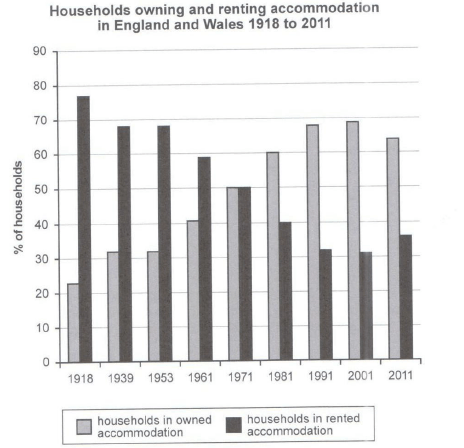
The chart below shows the percentage of households in owned and rented accommodation in England and Wales between 1918 and 2011.
Summarize the information by selecting and reporting the main features and make comparisons where relevant.
Student answer (Band 6.0)
The chart illustrates the percentage of residents owning and renting accomodation in England and Wales between 1918 and 2011.
From the chart it is visible that owning houses is becoming more common with time. More and more people are owning the house they live in. On the other hand, renting house is slowly going out of fashion.
If we take a closer look, in 1918 around 78% of people used to rent their accomodation while 22% of people owned their house. This was the highest percentage of rented accomodation for the research period. The percentage of household owners increased to 32% in 1939. But the percentage of households in rented accomodation dropped to 68%. 1953 and 1961 keeps following the same trend til we reach 1971. In 1971, the people renting and owning their households become even at 50%. After that the percentage of households keep decreasing and reach their lowest point at 31% in 2001. It was also the year when the most of households owned their accomodation.
AI examiner evaluation
| Criterion | Band |
|---|---|
| Task Achievement / Task Response | 6.0 |
| Coherence and Cohesion | 6.0 |
| Lexical Resource | 5.5 |
| Grammatical Range and Accuracy | 6.0 |
| Overall | 6.0 |
Task Achievement / Task Response: Band 6.0
You identify the main long-term pattern: ownership generally rises while renting falls, and you report the crossover at 50% in 1971. Several figures are accurate, including the 1918 split and the rented low of about 31% in 2001. However, the overview is incomplete because it presents the trends as continuing without noting the reversal by 2011: ownership falls to 64% and renting rises to 36%. The account also says 2001 had the most owner-occupiers, although ownership peaked slightly earlier, at about 69% in 2001, before declining; this is close but should be stated precisely. The middle years are compressed into “keeps following the same trend,” leaving some key changes underdeveloped. Include the final-year figures and a clearer overview of the peak and reversal.
Coherence and Cohesion: Band 6.0
The response has a generally clear sequence, moving from an opening overview to earlier figures, the 1971 crossover, and the later low in renting. Phrases such as “On the other hand,” “If we take a closer look,” and “After that” help signal relationships between points. However, the paragraphing is limited, and the progression becomes less precise when 1953 and 1961 are grouped together without their figures or a clear explanation of the changes. The final sentence also ends the account at 2001, so the reader is not guided through the full timeline to 2011. Organise the response into a concise overview and a chronological detail paragraph, using clear links to cover the final period as well.
Lexical Resource: Band 5.5
You use enough topic vocabulary to communicate the main comparison, including “percentage,” “households,” “owned,” and “rented accommodation.” Some variation, such as “going out of fashion,” makes the trend understandable, but it is informal and imprecise for an academic chart description. There are also repeated phrases such as “percentage of households” and “accommodation,” which limit flexibility. Spelling errors in “accomodation” occur more than once, and expressions such as “people renting and owning their households” are not natural collocations. Aim for concise, formal terms that describe the data directly, such as “home ownership,” “rental accommodation,” and “the proportion of households.”
Grammatical Range and Accuracy: Band 6.0
You use a mix of simple statements and longer sentences, and the main meaning is usually clear. Some grammatical errors remain, particularly with tense and agreement: “1953 and 1961 keeps following” should use a plural verb, while “the percentage … keep decreasing” needs singular agreement. The shift between past data and present commentary is also inconsistent, as in “owning houses is becoming more common” followed by “used to rent.” In “the people renting and owning their households become even,” the verb form and sentence construction are awkward. Use the past tense consistently for the historical figures, and check subject–verb agreement and sentence structure when describing multiple years or proportions.
See this exact question answered at other band scores. The same prompt compared across bands.
Browse more IELTS Writing model answers or get your own writing scored by the same AI examiner.