Band 6.0 IELTS Writing Task 1 Model Answer
Overall Band Score: 6.0 · Cambridge IELTS 13 · 2026-11-21
IELTS Writing Task 1 question
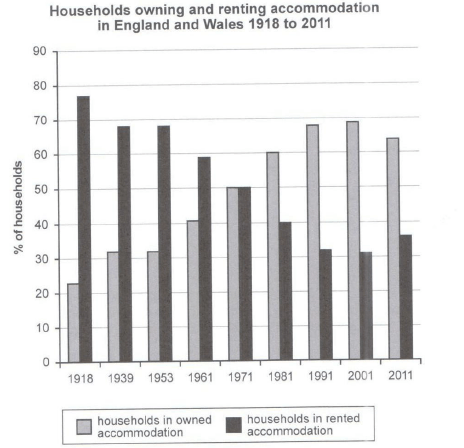
The chart below shows the percentage of households in owned and rented accommodation in England and Wales between 1918 and 2011.
Summarize the information by selecting and reporting the main features and make comparisons where relevant.
Student answer (Band 6.0)
The chart illustrates the proportion of households owning and renting their accommodation in England and Wales between 1918 and 2011.
The percentage of house owners have grown throughout the years whereas renting house has become less often throughout the years. The percentage of house owners and renters became equal at 1971 and maximum households owned their houses by 2001.
78% of households rented their accomodation in 1918 while 22% owned their residence. The following decades the percentage of house owners increased and the percentage of renters decreased. In 1971, half of the households owned their residence and the other half was living on rented houses.
This trend of increasing house owners followed and the percentage of house owners peaked at 69% in 2001 and the percentage of renters reached an all time low at 31%. Although in 2011, the rate of people owning their accommodation decreased a little bit and reached 64% while the percentage of people renting their residence increased to 36%. Nevertheless, owning houses remained the most common trend at the end of the survey period.
AI examiner evaluation
| Criterion | Band |
|---|---|
| Task Achievement / Task Response | 7.0 |
| Coherence and Cohesion | 5.5 |
| Lexical Resource | 6.0 |
| Grammatical Range and Accuracy | 6.0 |
| Overall | 6.0 |
Task Achievement / Task Response: Band 7.0
You give a clear overview of the main pattern: ownership generally rose while renting declined, the figures met in 1971, and ownership remained more common in 2011. The key turning points are also reported accurately: ownership peaked at 69% in 2001 before falling to 64%, while renting reached 31% and then rose to 36%. Your opening figures, 78% rented and 22% owned, differ slightly from the chart’s approximate 77% and 23%, but this is a minor discrepancy. The response covers the period and makes relevant comparisons. To strengthen it further, report the plateau in 1939 and 1953, when both figures stayed unchanged, rather than describing the intervening decades only generally.
Coherence and Cohesion: Band 5.5
The response has a recognisable structure, moving from an introduction and overview to chronological details and a final comparison. This makes the main trend easy to follow. However, progression within the body is somewhat repetitive: the general rise in ownership and fall in renting is stated in the overview and then repeated in the third paragraph without adding much detail. Linking phrases such as “The following decades” and “This trend” are understandable but do not clearly identify which years or changes they refer to. The final paragraph also combines the 2001 peak with the 2011 reversal in a long sequence. Grouping the early period, the crossover, and the later peak and decline into clearly signposted stages would make the organisation more coherent and cohesion less mechanical.
Lexical Resource: Band 6.0
You use relevant vocabulary for describing the chart, including “proportion,” “peaked,” “decreased,” and “remained the most common,” so the trends are generally clear. There is some variety in how you describe ownership and renting, although several phrases are awkward or imprecise. For example, “renting house has become less often” is not a natural way to describe a falling percentage, and “maximum households owned their houses” is unclear. “All time low” communicates the idea but is less precise than language referring to the lowest proportion. There is also a spelling error in “accomodation.” Aim for accurate collocations and consistent terms such as “households in owner-occupied accommodation” and “the proportion renting.”
Grammatical Range and Accuracy: Band 6.0
You use both simple and more complex sentence forms, including a contrast introduced by “Although” and a concluding sentence beginning “Nevertheless.” Most of the information remains understandable, but some grammatical errors are noticeable. In “The percentage of house owners have grown,” the singular subject “percentage” requires “has grown.” The phrase “became equal at 1971” needs the preposition “in,” and “the other half was living on rented houses” has an awkward structure and tense choice. The sentence beginning “Although in 2011” is also incomplete as written because “although” introduces a dependent clause without a complete main clause. Check subject–verb agreement, prepositions with years, and clause structure when using contrast linkers.
See this exact question answered at other band scores. The same prompt compared across bands.
Browse more IELTS Writing model answers or get your own writing scored by the same AI examiner.