Band 5.5 IELTS Writing Task 1 Model Answer
Overall Band Score: 5.5 · Cambridge IELTS 13 · 2026-11-21
IELTS Writing Task 1 question
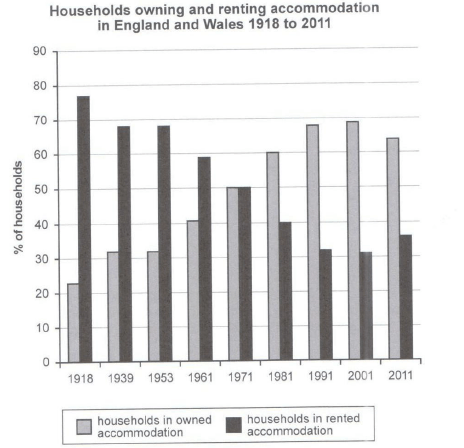
The chart below shows the percentage of households in owned and rented accommodation in England and Wales between 1918 and 2011.
Summarize the information by selecting and reporting the main features and make comparisons where relevant.
Student answer (Band 5.5)
The chart illustrate the propotion of households in owned or rented accommodation in England and wales between 1918 and 2011.
Overall, it is evident that the highest percentage of households recorded in rented accommodation and then the percentage dropped considerably over the period. In contrast, the percentage of households owned accommodation recorded lowest and rose significantly over the period.
In 1918, the proportion of households in owned accommodation were at approximately 23 percent and rented accommodation recorded highest at approximately 77 percent. The percentage of households in owned accommodation gradually rose and reached approximately 32 percent while, in rented accommdation percenatge declined steadily and reached approximately 67 percent in 1939. The proportion of households in both accommodation remained stable in 1953.
In 1961, the figure in owned accommodation continue to rose and reached 40 percent while, the figure in rented accommodation experience a sight fall and reached approximately 58 percent. In 1971, the percentage stayed relatively unchganed in both accommodation. The percentage rose significantly in owned accommodation and reached approximately 79 percent in 2001 before falling to approximately 63 percent while, the percentage in rented continue to drop and re
AI examiner evaluation
| Criterion | Band |
|---|---|
| Task Achievement / Task Response | 5.5 |
| Coherence and Cohesion | 5.5 |
| Lexical Resource | 5.5 |
| Grammatical Range and Accuracy | 5.0 |
| Overall | 5.5 |
Task Achievement / Task Response: Band 5.5
You identify the main contrast: ownership rises over time while renting generally falls, and you include several early figures. However, the overview is imprecise: renting starts at its highest point and ownership at its lowest, rather than these being simply “recorded” high and low. More importantly, the account of later years contains a major factual error: ownership peaks at about 69% in 2001, not 79%, and then falls to about 64% in 2011. The response also ends mid-sentence, leaving the final rented-accommodation figure and the end of the period inadequately reported. To strengthen the response, give a complete account of the later trend and accurately highlight the crossover at 1971, when both figures are 50%.
Coherence and Cohesion: Band 5.5
The response has a recognisable structure, with an introduction, an overview and paragraphs describing the data chronologically. Time markers such as “In 1918,” “In 1961” and “In 1971” help readers follow the sequence. However, progression becomes difficult near the end because the final sentence is unfinished (“and re”), and the 1981 and 1991 data are skipped without explaining the trend between 1971 and 2001. Some linking is also awkward or repetitive, particularly the repeated “while” constructions. Organise the body into clear stages, include the key intervening years or summarise them accurately, and ensure each sentence is complete. This would make the overall progression clearer and cohesion less mechanical.
Lexical Resource: Band 5.5
You use relevant task vocabulary, including “proportion,” “percentage,” “gradually rose,” “declined steadily” and “remained stable,” so the reader can understand the broad trends. However, the range is limited and several word-choice or spelling problems reduce precision: “recorded highest” is unnatural, “sight fall” appears to mean “slight fall,” and “propotion,” “accommdation” and “percenatge” are misspelled. Phrases such as “households owned accommodation” also need a more natural form. Aim for accurate collocations and vary the language used to describe increases, decreases and levels. Proofreading spelling and choosing standard chart-reporting phrases would make the description clearer and more controlled.
Grammatical Range and Accuracy: Band 5.0
You attempt both simple and longer sentences, including comparisons joined with “while,” but complex structures are often faulty and errors occur frequently. For example, “The chart illustrate” has subject–verb disagreement, while “the proportion … were” also mismatches the singular subject and verb. “The figure … continue to rose” combines an incorrect verb form with an unsuitable infinitive pattern, and “the percentage … continue to drop” lacks the required past-tense form. Articles and prepositions are also inconsistent in phrases such as “in owned accommodation.” Use a reliable past-tense pattern throughout, check subject–verb agreement, and build comparisons as complete clauses. Shorter, accurately controlled sentences would help before adding more complex structures.
See this exact question answered at other band scores. The same prompt compared across bands.
Browse more IELTS Writing model answers or get your own writing scored by the same AI examiner.