Band 5.5 IELTS Writing Task 1 Model Answer
Overall Band Score: 5.5 · Cambridge IELTS 13 · 2026-11-21
IELTS Writing Task 1 question
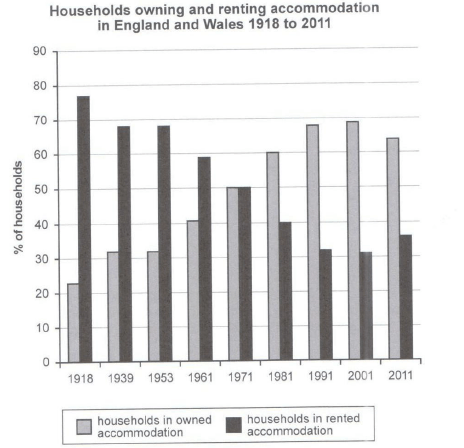
The chart below shows the percentage of households in owned and rented accommodation in England and Wales between 1918 and 2011.
Summarize the information by selecting and reporting the main features and make comparisons where relevant.
Student answer (Band 5.5)
The bar chart illustrates the information related to accomodation like owned or rented houses in England and Wales through 1918 to 2011.
Overall, from 1918 to 1971 rented accomodation is super high in contrast of private houses. But from 1981 to 2011 rental houses percentage became dropped very rapidly and self-owned houses increased in large amount.
In 1918,rented property was very high rather than the others years, almost 78% people lived in them. Between 1939 to 1961, gradually reduced the amunt of rented accomodation and in 1971, the percentage of rented and self-owned properties reached at same level means 50% rented houses and 50% private accomodation were available.
In contrast, from 1981 to 2001 the owned accomodation suddenly rosen and reached at 68%. Then in 20011, rented houses became slightly again high and owner-occupied houses percentage dropped and hit the level of 63%. so the pere
AI examiner evaluation
| Criterion | Band |
|---|---|
| Task Achievement / Task Response | 5.5 |
| Coherence and Cohesion | 5.5 |
| Lexical Resource | 5.0 |
| Grammatical Range and Accuracy | 5.0 |
| Overall | 5.5 |
Task Achievement / Task Response: Band 5.5
You identify the chart’s main contrast and the key turning point: renting falls while ownership rises, and the two reach 50% in 1971. Several figures are broadly accurate, including about 78% renting in 1918 and ownership reaching roughly 68–69% around 1991–2001. However, the overview is imprecise: renting did not drop “very rapidly” after 1981, and ownership did not rise substantially from 1981 to 2001, but increased from 60% to about 69%. The final year is also misreported: ownership was about 64%, not 63%, while renting rose to 36%. The response ends mid-sentence and contains 146 words, below the 150-word minimum, so the summary is incomplete. Include a concise, accurate overview and finish the final comparison.
Coherence and Cohesion: Band 5.5
The response has a recognisable structure, moving from an introduction and overview to chronological details, and phrases such as “Overall” and “In contrast” help signal relationships. However, progression is weakened by unclear or awkward links, for example “Between 1939 to 1961, gradually reduced” does not identify what is reducing, and “rather than the others years” makes the comparison difficult to follow. The final sentence is cut off (“so the pere”), leaving the account unfinished. Paragraphing is present, but the information would be easier to track if each paragraph had a clear purpose: overview first, then the early decline in renting, followed by the later rise in ownership and the 2011 reversal.
Lexical Resource: Band 5.0
You use some relevant topic vocabulary, including “rented accommodation,” “percentage,” and “owner-occupied houses,” so the subject is generally clear. However, the range is limited and several choices are inaccurate or unnatural, such as “super high,” “private houses,” “suddenly rosen,” and “became slightly again high.” Repeated use of “houses” also obscures the fact that the chart measures household tenure, not the number of houses available. Spelling errors such as “accomodation,” “amunt,” and “pere” further reduce precision. Aim for standard chart language and accurate collocations, such as “the proportion of households renting fell” and “home ownership increased,” while checking spelling before submitting.
Grammatical Range and Accuracy: Band 5.0
You attempt both simple and more complex sentences, including a contrast introduced by “But” and a sentence describing the 1971 equality. However, control is inconsistent, and errors sometimes make relationships unclear. For example, “Between 1939 to 1961, gradually reduced” lacks a clear subject and uses an incorrect time construction; “reached at same level” has an incorrect verb pattern and missing article; and “rented houses percentage dropped” has faulty word order. There are also punctuation and sentence-boundary problems, including the lowercase “so” after a full stop and the unfinished final clause. Build accurate basic sentences first, then add subordinate clauses, checking subjects, verb forms, articles, and punctuation.
See this exact question answered at other band scores. The same prompt compared across bands.
Browse more IELTS Writing model answers or get your own writing scored by the same AI examiner.