Band 5.5 IELTS Writing Task 1 Model Answer
Overall Band Score: 5.5 · Cambridge IELTS 13 · 2026-11-22
IELTS Writing Task 1 question
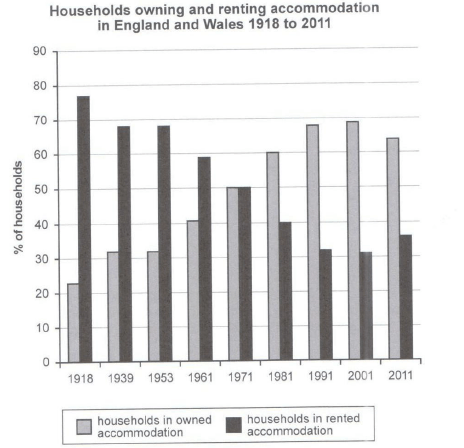
The chart below shows the percentage of households in owned and rented accommodation in England and Wales between 1918 and 2011.
Summarize the information by selecting and reporting the main features and make comparisons where relevant.
Student answer (Band 5.5)
The graph compares the proportion of households owned and rented accomodation in England and Wales from 1918 to 2011. It is clear that the percentage of households in owned accomodation is highest in 1918 and least in 2001, whereas the percentage of households in rented accomodation is is highest in 2001 and lowest in 1918.
The household in owned accomodation has been steadily increasing from 1918 to 2001 and a slight fall in 2011. In 1918, around 25% of households preferred owned accomodation as compared to around 78% preferring rented accomodation. In addidtion to that households in rented accomodation dropped to 50% which equaled households in owned accomodation.
On the other hand the households in rented accomodation has recorded a downward trend but in 2011 a slight increase be recorded.
Overall, a change in trend is clearly visible as percentage of households in owned accomodation is increases and of households in rented accomodation has a declining trend.
AI examiner evaluation
| Criterion | Band |
|---|---|
| Task Achievement / Task Response | 5.5 |
| Coherence and Cohesion | 5.5 |
| Lexical Resource | 5.5 |
| Grammatical Range and Accuracy | 5.5 |
| Overall | 5.5 |
Task Achievement / Task Response: Band 5.5
You identify the two categories and describe the broad movement from renting towards ownership, including the equal 50% shares in 1971 and the small reversal by 2011. However, the opening overview misstates the extremes: ownership was lowest in 1918 and highest in 2001, while renting showed the opposite, not the pattern you report. The body gives only a few figures and does not clearly trace the main stages, such as ownership rising from 23% to 69% before falling to 64%. Your final overview repeats the general trend but does not correct the earlier error. To strengthen the response, give an accurate overview first, then select key figures to support the long-term change and the 2011 reversal.
Coherence and Cohesion: Band 5.5
The response has a basic paragraph structure, moving from an introduction and overview to supporting details and a concluding summary. The comparison in “around 25% ... as compared to around 78%” is useful, and “On the other hand” signals a contrast. However, progression is limited because the same broad trend is repeated in the opening, body and conclusion without adding much new information. Some linking is also awkward: “In addition to that” does not clearly connect the following point, and the relationship between the 50% figure and the earlier comparison could be expressed more directly. Organise the body chronologically, grouping the rise in ownership and fall in renting, then the later reversal, and use references that make each comparison clear.
Lexical Resource: Band 5.5
You use relevant task vocabulary such as “proportion,” “percentage,” “downward trend” and “slight fall,” so the reader can understand the topic and general changes. However, the range is limited and several phrases are repetitive, especially repeated uses of “households in owned accommodation.” Some word combinations are unnatural, including “households ... preferred owned accommodation,” since the chart reports accommodation status rather than preference, and “a slight increase be recorded.” There are also spelling errors in “accomodation” and “addidtion.” Aim for more precise chart language and vary the phrasing with terms such as “owner-occupied homes,” “the share of households,” and “rose/fell.”
Grammatical Range and Accuracy: Band 5.5
You attempt both simple and more complex sentences, including a contrast with “whereas” and a comparison using “as compared to.” Meaning is generally recoverable, but errors recur in verb forms, agreement and sentence construction. For example, “The household ... has been steadily increasing” needs a plural subject or a different construction, while “a slight increase be recorded” lacks the correct verb form. The opening also contains “is is,” and the final sentence has faulty agreement and structure: “is increases and ... has a declining trend.” These errors make parts of the response less clear. Practise accurate present and past forms for describing chart trends, and check subject–verb agreement and sentence boundaries when editing.
See this exact question answered at other band scores. The same prompt compared across bands.
Browse more IELTS Writing model answers or get your own writing scored by the same AI examiner.