Band 4.5 IELTS Writing Task 1 Model Answer
Overall Band Score: 4.5 · Cambridge IELTS 13 · 2026-11-23
IELTS Writing Task 1 question
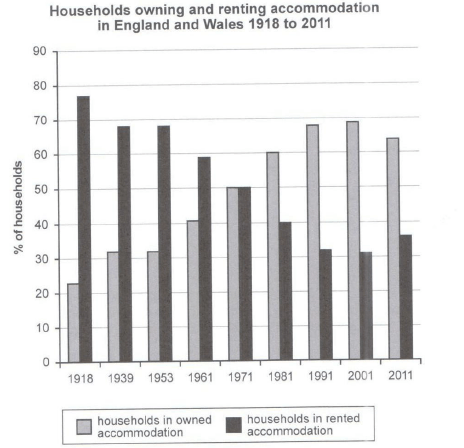
The chart below shows the percentage of households in owned and rented accommodation in England and Wales between 1918 and 2011.
Summarize the information by selecting and reporting the main features and make comparisons where relevant.
Student answer (Band 4.5)
The bar chart comapares , the percentage of households in owned and rented between 1918 and 2011.
In board terms , the household in 1918 rented houses are more than the owned houses .There is vast difference between them . In this year the percentage of accomadation are high . The both household are equal in 1971 .
In contrast , the rented house are available more than the owned house . The people like to live in others house by paying. From 1981 the pattern of living life was changed . The people in this year would changed and started to make their own rather than live in somebody's houses. We can clearly saw that the owned household in 1971 grew up bu 20 percent .In the next year the owned household rose sharply. In the last year the owned household was 65 percent and the rented was half of this .
In conclusion , the people follow the same pattern unitil 1971 . In the beginning they dose not give pairorty to owned house after some year they realised the importance of owned house .
AI examiner evaluation
| Criterion | Band |
|---|---|
| Task Achievement / Task Response | 5.0 |
| Coherence and Cohesion | 4.5 |
| Lexical Resource | 4.5 |
| Grammatical Range and Accuracy | 4.5 |
| Overall | 4.5 |
Task Achievement / Task Response: Band 5.0
You identify the broad shift from renting to owning and note that the two figures meet in 1971, which are relevant main features. However, the account only partially reports the chart: it gives little accurate detail about the earlier and later stages, and the claim that people followed the same pattern until 1971 is unclear. Some figures are misreported: ownership rose by 20 percentage points from 1971 to 1991, not in 1971, and in 2011 renting was 36%, not half of ownership (64%). The explanation about people changing their preferences is speculation rather than information shown by the chart. To improve, give a clear overview and compare the main figures and turning points accurately.
Coherence and Cohesion: Band 4.5
The response has an opening, several body paragraphs and a conclusion, and connectors such as “In contrast” and “In conclusion” show an attempt to guide the reader. However, the progression is difficult to follow because the comparisons are not consistently organised by time or by accommodation type. For example, “In contrast” introduces a statement that does not clearly contrast with the preceding point, while “From 1981” is followed by an explanation of people’s behaviour rather than a clear chart comparison. References such as “this year” and “the next year” are also unclear. Organise the report into an overview and chronological comparisons, using precise links between each figure and its year.
Lexical Resource: Band 4.5
You use some relevant topic vocabulary, including “percentage,” “owned,” “rented,” and “rose sharply,” so the subject is generally recognisable. However, the range is limited and several word choices or collocations are inaccurate, which makes parts of the report difficult to interpret. Phrases such as “the pattern of living life,” “make their own,” and “follow the same pattern” do not express the chart trends precisely. There are also noticeable spelling errors, including “comapares,” “accomadation,” and “pairorty.” Use standard chart language such as “the proportion of households,” “home ownership increased,” and “the figures converged,” and check spelling carefully.
Grammatical Range and Accuracy: Band 4.5
You attempt both simple and longer sentence forms, but control is inconsistent, and errors frequently affect clarity. Examples include “the household in 1918 rented houses are more,” where the subject and verb do not agree, and “We can clearly saw,” which uses an incorrect verb form. In “the owned household in 1971 grew up bu 20 percent,” the tense and sentence construction make the intended comparison unclear. Articles, plurals and sentence boundaries are also unreliable, as in “The both household are equal.” Aim first for accurate, complete sentences with a clear subject and verb; then practise past-tense reporting forms such as “ownership increased” and “renting fell.”
See this exact question answered at other band scores. The same prompt compared across bands.
Browse more IELTS Writing model answers or get your own writing scored by the same AI examiner.