Band 5.0 IELTS Writing Task 1 Model Answer
Overall Band Score: 5.0 · Cambridge IELTS 13 · 2026-11-23
IELTS Writing Task 1 question
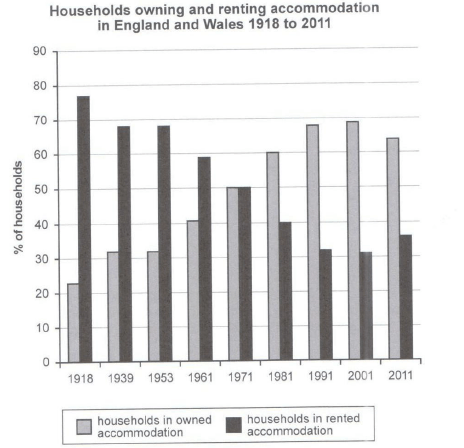
The chart below shows the percentage of households in owned and rented accommodation in England and Wales between 1918 and 2011.
Summarize the information by selecting and reporting the main features and make comparisons where relevant.
Student answer (Band 5.0)
The bar chart compares the percentage of household in owned and rented accommodation in england city and wales between 1918 and 2011.
Overal,household in owned accommodation in 1918 23 % percent lowest percentage while, lower then rented houses 78%, In 1939 owned home 33% and rented 68% and higher then owned housees decrease privious year some percentage and rented increased,In 1953 highly increase rented house and decrease owned houses, In 1961 owned house perccentage increase and rented percentage is decraese.
Regarding to the first catogery, in1918 very low percentage of the own houses and highest percenatge of rented houses moreever,In 1939 owned houses minor increase and rented house are minorly decrease but, In 1953 rented house are increase and owned house are decreas.
Turning to the remaining figures, Highest increased owned houses percentageb 2001 and highly decrease rented houses percentage all over the years are different changes in the percentage ,In 2011 owned house minor decrease and rented houses people are increased.
AI examiner evaluation
| Criterion | Band |
|---|---|
| Task Achievement / Task Response | 5.0 |
| Coherence and Cohesion | 4.5 |
| Lexical Resource | 5.0 |
| Grammatical Range and Accuracy | 4.5 |
| Overall | 5.0 |
Task Achievement / Task Response: Band 5.0
You identify the two categories and give some relevant figures, including the starting proportions and the rise in ownership toward 2001. However, the response only partially reports the chart’s main features. The overview is unclear, and several descriptions contradict the data: in 1953 both figures remain unchanged from 1939, rather than ownership decreasing and renting increasing. The chart also shows ownership peaking at about 69% in 2001 before falling to 64% in 2011, while renting follows the opposite pattern; these key trends are not clearly summarised. Some figures, such as 78% and 33%, are close to the chart, but comparisons across the full period need to be more accurate and selective.
Coherence and Cohesion: Band 4.5
There is an attempt to organise the response into an introduction, an overview and two detail paragraphs, and phrases such as “Regarding to the first category” and “Turning to the remaining figures” signal a change of focus. However, the progression is difficult to follow because the paragraphs repeat the early years and do not group the data into clear stages. Several sentences run together, with commas joining separate ideas, as in the overview beginning “In 1939 owned home…”. The links “moreover” and “but” are also used where the relationship between ideas is unclear. A clearer sequence—overall trend, early years, then later years—would make the comparisons easier to understand.
Lexical Resource: Band 5.0
The response uses some relevant chart vocabulary, including “percentage,” “owned accommodation,” “rented houses,” “increase” and “decrease,” so the topic is generally recognisable. However, the range is limited and several word choices or collocations are inaccurate or repetitive, such as “highly increase,” “minorly decrease,” and “highest increased.” Spelling errors including “Overal,” “perccentage,” “catogery” and “decaese” also reduce clarity. Use precise trend language and vary the nouns and verbs: for example, describe a figure as “remaining stable,” “rising steadily,” or “reaching a peak.” Check spelling and use standard forms such as “percentage” and “accommodation.”
Grammatical Range and Accuracy: Band 4.5
You attempt to form longer sentences and use time references, but sentence structures are limited and errors are frequent enough to make some statements difficult to interpret. For example, “In 1953 highly increase rented house and decrease owned houses” lacks a clear subject and correctly formed verbs. There are also problems with articles, plurals and agreement in phrases such as “percentage of household” and “rented houses people are increased.” Punctuation is inconsistent: several clauses are joined by commas without full stops, and spacing around commas is irregular. Build accurate simple sentences first, then add controlled comparisons using structures such as “while” and “whereas.”
See this exact question answered at other band scores. The same prompt compared across bands.
Browse more IELTS Writing model answers or get your own writing scored by the same AI examiner.