Band 6.0 IELTS Writing Task 1 Model Answer
Overall Band Score: 6.0 · Cambridge IELTS 13 · 2026-11-24
IELTS Writing Task 1 question
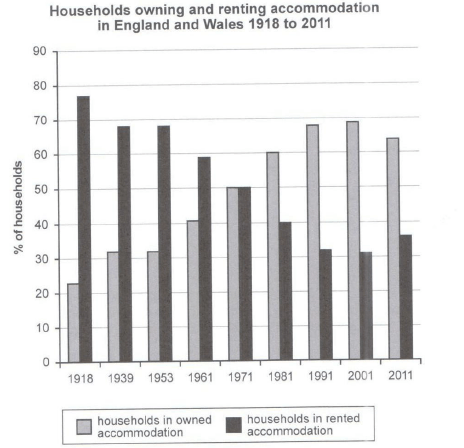
The chart below shows the percentage of households in owned and rented accommodation in England and Wales between 1918 and 2011.
Summarize the information by selecting and reporting the main features and make comparisons where relevant.
Student answer (Band 6.0)
The bar chart illustrates the proportion of households in owned and rented accommodation in England and Wales from 1918 to 2011.
Overall, it is clear that households in rented accommodation was high at start. While this trend was reversed and households in owned accommodation had the highest percentage at the end.
In 1918, rented houses stood at 78%, compared with 22% of owned houses. In 1939 and 1953 both had 69% of rented properties and 31% of owned houses. Furthermore, in 1961, 59% of rented houses, followed by 40% of owned houses. In 1971, this was the only year where both trends had the same figure at 50%.
In 1981, trend reversed 60% of owned houses and 40% of rented. In addition, in 1991 and 2001, 69% of owned houses and 31% of rented houses. Finally, in 2011, 63% of owned houses and 38% of rented houses. In summary, rented houses demand was high at the start whereas this trend changed to owned houses in next years.
AI examiner evaluation
| Criterion | Band |
|---|---|
| Task Achievement / Task Response | 6.5 |
| Coherence and Cohesion | 6.5 |
| Lexical Resource | 6.0 |
| Grammatical Range and Accuracy | 5.5 |
| Overall | 6.0 |
Task Achievement / Task Response: Band 6.5
You cover the full period and identify the central shift from renting being more common at the beginning to ownership becoming more common later. The overview also notes the equal 50% split in 1971, and most reported figures are close to the chart. However, the overview is not fully accurate: ownership does not remain highest at the end, since the two categories are still 64% and 36% in 2011, but the ownership share falls from its 2001 peak. Some figures are also slightly off, such as 1939 and 1953 (32% owned, 68% rented) and 2001 (69% owned, 31% rented). The final summary repeats the trend rather than adding a clear comparison. A more precise overview and accurate reporting of the later change would strengthen the response.
Coherence and Cohesion: Band 6.5
The response has a clear overall arrangement: an introduction, an overview, and chronological detail grouped into the earlier and later years. This makes the main progression easy to follow, and linking expressions such as “Furthermore,” “In addition,” and “Finally” help signal sequence. However, some connections are mechanical or unclear. For example, “In 1961, 59% of rented houses, followed by 40% of owned houses” is not a complete sentence, and “In 1981, trend reversed” does not clearly connect the figures to the preceding comparison. The final “In summary” repeats the overview without adding information. Use complete, parallel comparisons and vary the linking so that relationships between figures, rather than just their order, are explicit.
Lexical Resource: Band 6.0
You use an adequate range of task-related vocabulary, including “proportion,” “accommodation,” “percentage,” and “reversed,” and the meaning is generally clear. There are, however, some imprecise or unnatural choices. “Rented houses demand” suggests demand for housing rather than the share of households renting, while “trend was reversed” is less precise than describing the change in the proportions. Repeated use of “houses” also blurs the distinction between households and properties, and “both had 69% of rented properties” is awkwardly phrased. Aim for accurate collocations and consistent terms such as “households in rented accommodation” and “the proportion of owner-occupied households.” This would make the description more precise without requiring more elaborate vocabulary.
Grammatical Range and Accuracy: Band 5.5
You attempt both simple and more complex forms, including the contrast in “While this trend was reversed…” and the comparison “compared with 22% of owned houses.” Most of the message remains understandable, but some grammatical errors and incomplete constructions limit accuracy. In the overview, “households … was high at start” has a subject–verb agreement error and is missing an article; the following “While” clause is also a fragment. “In 1961, 59% of rented houses, followed by 40% of owned houses” lacks a main verb, and “In 1981, trend reversed” is missing an article. Practise complete sentences with a clear subject and verb, and check agreement and articles. More consistently accurate complex sentences would improve control.
See this exact question answered at other band scores. The same prompt compared across bands.
Browse more IELTS Writing model answers or get your own writing scored by the same AI examiner.