Band 6.0 IELTS Writing Task 1 Model Answer
Overall Band Score: 6.0 · Cambridge IELTS 13 · 2026-11-24
IELTS Writing Task 1 question
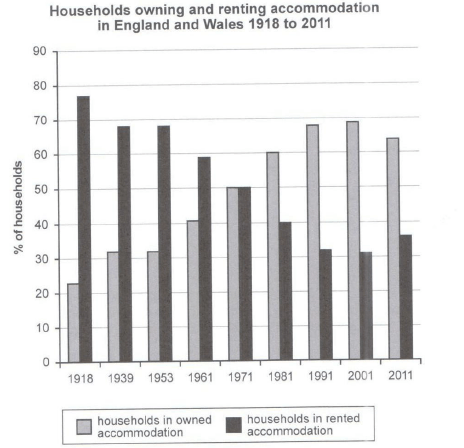
The chart below shows the percentage of households in owned and rented accommodation in England and Wales between 1918 and 2011.
Summarize the information by selecting and reporting the main features and make comparisons where relevant.
Student answer (Band 6.0)
The chart illustrates the proportion of households whether they are owned or rented in England and Wales from 1918 to 2011.
Popularity of accomodation type shifted drastically over the time as people were leaning to owning the household rather than renting. The gradual change of the proprtion over the few decades had lead to levelling of in the midpoint before ownership of the houseold took over.
In 1918, around 23% households were owned accomodation and 77% were rented. Over the next years households in owned accommodation kept rising and renting kept plumiting before levelling off.
From 1971, ownership of households were around 60% and rented accommodation was apporximately 40%. Owning percentage kept increasing until 2001 before slightly decreasing in 2011 with around 64% of household under ownership and approximately 36% household relied on renting . Ownership of household kept increasing as the years went by, on the otherside renting became less popular
AI examiner evaluation
| Criterion | Band |
|---|---|
| Task Achievement / Task Response | 6.0 |
| Coherence and Cohesion | 6.0 |
| Lexical Resource | 5.5 |
| Grammatical Range and Accuracy | 5.5 |
| Overall | 6.0 |
Task Achievement / Task Response: Band 6.0
You identify the overall shift from renting to ownership and include accurate figures for 1918 and 2011. You also note that ownership peaked around 2001 before falling slightly, which is an important feature. However, the overview is not fully clear: the claim that the proportions levelled off “in the midpoint” is vague, and the response does not clearly explain that the two categories were equal at 50% in 1971. There is also a significant date-and-value mismatch in “From 1971, ownership … around 60%”: ownership was 50% in 1971 and reached 60% in 1981. Several intermediate stages are only broadly described. A clearer overview and more precise comparisons across the period would make the report more complete.
Coherence and Cohesion: Band 6.0
The response has a recognisable structure, moving from an introduction to an overview and then to figures, so the reader can follow its general direction. The chronological approach is appropriate, and phrases such as “Over the next years” and “before slightly decreasing in 2011” help connect changes. However, the progression is weakened by repetition: the final sentence repeats the general trend already stated in the overview. Some references are unclear, particularly “From 1971,” which introduces figures that actually describe 1981, and “the midpoint” does not specify the period or values meant. Paragraphing is present, but the report would be more cohesive if each paragraph had a distinct purpose and comparisons between the two categories were linked more explicitly.
Lexical Resource: Band 5.5
You use some relevant chart vocabulary, including “proportion,” “levelling off,” “increasing,” and “decreasing,” and the main trends remain understandable. There are also attempts at more descriptive language, such as “shifted drastically” and “plummiting.” However, several word choices or collocations are inaccurate or awkward: households are not “owned,” and “people were leaning to owning the household” is not a natural way to describe the data. “Popularity” also suggests preference, which the chart does not measure. Spelling errors such as “accomodation,” “proprtion,” and “apporximately” reduce accuracy. Use precise terms such as “the proportion of households in owner-occupied homes” and check spelling carefully.
Grammatical Range and Accuracy: Band 5.5
You attempt both simple and more complex sentence forms, and the main message is generally understandable. Some sentences are controlled, for example, “Owning percentage kept increasing until 2001 before slightly decreasing in 2011.” However, there are some errors in sentence structure, agreement, and articles. In “the proportion of households whether they are owned or rented,” the clause is not grammatically formed; “households in owned or rented accommodation” would be clearer. “Ownership of households were around 60%” has subject–verb disagreement, while “23% households” needs an article or a different construction. The final sentence also lacks a full stop, and “on the otherside” is not correctly punctuated as a linking phrase. More consistent control of these patterns would improve accuracy.
See this exact question answered at other band scores. The same prompt compared across bands.
Browse more IELTS Writing model answers or get your own writing scored by the same AI examiner.