Band 5.0 IELTS Writing Task 1 Model Answer
Overall Band Score: 5.0 · Cambridge IELTS 13 · 2026-11-25
IELTS Writing Task 1 question
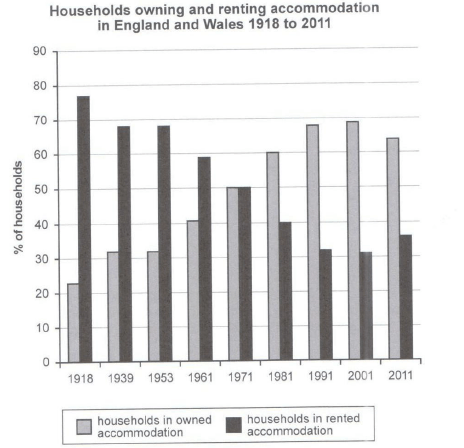
The chart below shows the percentage of households in owned and rented accommodation in England and Wales between 1918 and 2011.
Summarize the information by selecting and reporting the main features and make comparisons where relevant.
Student answer (Band 5.0)
The given chart illustrates the percentage of families in owned and rented accommodation in England and Wales, during the period from 1918 to 2011.
It is clear that, before 1971, most of the families lived in rented accommodation but after this decade this trends was falling gradually, while the number of families were increased in the same period who lived in their owned house. It is noticable from the chart is that the first 53 years most of the people were passed their lives in rented accommodation, in contrast very little amount of people had their own housed.
In 1918, approximately 77% households survived their lives in rented accommodation which is the highest value in this 90 years period. But this trends was reduced gradually day by day and in 2001, it reached at almost 31%. Though this amount was increased slightly in the following year, but not too much.
On the other hand, in 1918, only 22% people had their own housing facilities. But after that this percentage was growing very rapidly and after 53 years, in 1971, it became the same of owned accommodation. After that
AI examiner evaluation
| Criterion | Band |
|---|---|
| Task Achievement / Task Response | 5.5 |
| Coherence and Cohesion | 5.0 |
| Lexical Resource | 5.0 |
| Grammatical Range and Accuracy | 5.0 |
| Overall | 5.0 |
Task Achievement / Task Response: Band 5.5
You identify the main contrast: renting was more common early on, while ownership rose and the two reached parity in 1971. Several figures are broadly accurate, including rented accommodation at about 77% in 1918 and its low of roughly 31% in 2001. However, the account is only partial: it ends mid-sentence after “After that,” so the later ownership trend and the 2011 reversal are not reported. The overview also says renting fell after 1971, although it rose again from about 31% to 36% by 2011. To make the summary more complete, describe the full period, include the ownership peak around 69% in 2001 and its subsequent decline, and ensure the overview reflects both series.
Coherence and Cohesion: Band 5.0
The response has a recognisable sequence: an introduction and overview are followed by details about renting and then ownership. The contrast marker “On the other hand” helps signal the shift between the two categories. However, progression is weakened by repeated statements about the same early-period contrast, and the final paragraph stops abruptly at “After that,” leaving the comparison unfinished. Some links are also awkward or unclear, such as “Though this amount was increased slightly in the following year, but not too much,” where the relationship between the clauses is difficult to follow. Organise the details into a complete comparison of both trends, avoid repeating the overview, and use clear links between time periods.
Lexical Resource: Band 5.0
You use some relevant chart vocabulary, including “percentage,” “gradually,” “reduced,” and “increased,” and the reader can generally identify the two accommodation categories. However, the range is limited and several word choices or collocations are unnatural for describing data. For example, “families survived their lives in rented accommodation” and “passed their lives” do not express the neutral idea of living in rented homes; “very little amount of people” is also imprecise. Spelling errors such as “noticable” are noticeable. Choose concise, conventional terms for trends and proportions, and check spelling and collocation so the data description sounds clear and appropriately formal.
Grammatical Range and Accuracy: Band 5.0
You attempt both simple and more complex sentences, including clauses beginning “Though” and “while,” but control is inconsistent. Errors occur in verb forms and agreement: “this trends was falling” should use a singular noun with “was” or a plural noun with “were,” while “the number of families were increased” needs a different construction. The sentence “It is noticable from the chart is that…” has a faulty clause structure, and “after this decade this trends” also lacks accurate agreement and punctuation. The final sentence fragment further interrupts the grammar of the response. Practise accurate past-tense descriptions and build complex sentences around one clear main clause, checking agreement, articles, and punctuation.
See this exact question answered at other band scores. The same prompt compared across bands.
Browse more IELTS Writing model answers or get your own writing scored by the same AI examiner.