Band 6.0 IELTS Writing Task 1 Model Answer
Overall Band Score: 6.0 · Cambridge IELTS 13 · 2026-11-25
IELTS Writing Task 1 question
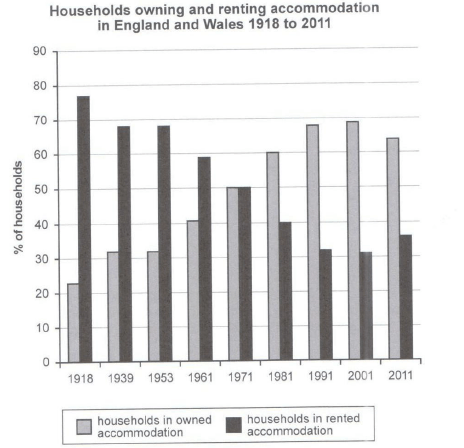
The chart below shows the percentage of households in owned and rented accommodation in England and Wales between 1918 and 2011.
Summarize the information by selecting and reporting the main features and make comparisons where relevant.
Student answer (Band 6.0)
The bar graph below illustrates the data related to households rented or owned for accomodation in England and Wales from 1918 to 2011. Overall, data showed constant fluctuation in terms of type of accomodation selected by public. Data is given in percentage unit.
In 1918 households in rented accomodation were record highest around 79%. Percentage dropped over the years gradually.The least percentage recorded for rented accomodation was in 2001 around 29%. But again rose to nearly 35% in 2011. Data showed similar results in 1939 and 1953 whereas, only 50 percent were living in rented properties in 1971. Equal to the number of people in owned accomodation.
Whereas, households in owned accomodatin was record lowest in year 1918 around 21 percent. This trend grew to the most in 2001 approximately 69%. In short, the decision of choosing own accomodation grew steadily among owners over the period given. In 2011 the percentage took a dip reaching around 62%.
AI examiner evaluation
| Criterion | Band |
|---|---|
| Task Achievement / Task Response | 6.0 |
| Coherence and Cohesion | 6.0 |
| Lexical Resource | 5.5 |
| Grammatical Range and Accuracy | 5.5 |
| Overall | 6.0 |
Task Achievement / Task Response: Band 6.0
You identify the main contrast and broad movement: renting falls from its high point in 1918, while ownership generally rises, and you note the equal 50% shares in 1971 and the reversal in 2011. Most figures are close to the chart, though the 1918 values are slightly overstated and the 2011 figures are a little understated; these are minor approximations. The overview is present, but “constant fluctuation” does not accurately summarise the mostly steady opposing trends, and the account could better highlight that ownership peaks in 2001 before declining. Some stages, such as the unchanged figures in 1939 and 1953, are mentioned but not clearly integrated into the overall comparison. A more precise overview and fuller selection of key turning points would strengthen the report.
Coherence and Cohesion: Band 6.0
The response has a clear overall arrangement: an introduction and overview are followed by details about renting and then ownership. This makes the two series easy to distinguish, and phrases such as “Whereas” and “In short” signal relationships between ideas. However, some connections are mechanical or unclear. “Data showed similar results in 1939 and 1953 whereas” leaves the relationship to the following sentence awkward, and “In short” introduces a detail about ownership rather than a genuine summary. The overview also sits within the opening paragraph without a clearly developed comparison. Use more precise links to show contrast and sequence, and make sure each paragraph has a distinct purpose and progression.
Lexical Resource: Band 5.5
You use relevant chart vocabulary, including “percentage,” “dropped,” “rose,” “grew,” and “took a dip,” so the main trends are generally understandable. There is some variety in how you describe change, but several choices are inaccurate or unnatural for formal data reporting: “constant fluctuation” mischaracterises the overall pattern, “record highest” is not idiomatic, and “percentage unit” is an awkward description of the measurement. Spelling errors such as “accomodation” and “accomodatin” also reduce accuracy. Aim for precise, conventional collocations and check spelling carefully; this will make your descriptions more natural and exact without requiring more complicated vocabulary.
Grammatical Range and Accuracy: Band 5.5
You attempt both simple and more complex sentence forms, including “Whereas, households in owned accomodatin was record lowest…” and “In short, the decision… grew steadily…”. The meaning is usually recoverable, but some grammatical errors remain. For example, “households… were record highest” has an incorrect verb construction, while “households… was record lowest” has a subject–verb agreement problem and an incomplete passive form. The sentence “Percentage dropped over the years gradually” also has awkward word order, and punctuation around “whereas” is not controlled. Practise accurate past-tense reporting and passive structures, and review agreement with plural subjects. More consistently accurate sentences would improve control while preserving your attempts at varied structures.
See this exact question answered at other band scores. The same prompt compared across bands.
Browse more IELTS Writing model answers or get your own writing scored by the same AI examiner.