Band 4.5 IELTS Writing Task 1 Model Answer
Overall Band Score: 4.5 · Cambridge IELTS 13 · 2026-11-27
IELTS Writing Task 1 question
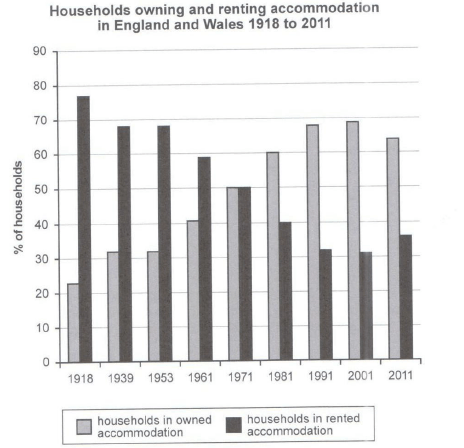
The chart below shows the percentage of households in owned and rented accommodation in England and Wales between 1918 and 2011.
Summarize the information by selecting and reporting the main features and make comparisons where relevant.
Student answer (Band 4.5)
The bar chart describes the shares of hosue hold in rented and owned accomodation in England and Wales beteeen 1918 to 2011.
Overall, household rented accomodation was on peak and change was it kept on decreasing while house hold in owned accomodation hit a low over and chnage was it started increasing but dramtically falls at end all the years,
In 1918, shares was 78%the highest one in rented accomodation and thendecreased to 69% and then remain stable 1953 , Again fall to 59% in 1971, while 22% percent share was in owned accomodation In1918,which rose upto 50 % in1971 same thing happened in rented accomodations there shares were same.
In 1981, owned kept on increasing but fals to65%in2011 while rented kept on falling but dramtically increase to 38% in 2011 by 75 ui
AI examiner evaluation
| Criterion | Band |
|---|---|
| Task Achievement / Task Response | 4.5 |
| Coherence and Cohesion | 5.0 |
| Lexical Resource | 4.5 |
| Grammatical Range and Accuracy | 4.5 |
| Overall | 4.5 |
Task Achievement / Task Response: Band 4.5
You identify the chart’s subject and report the broad shift from renting to owning, including the point where the figures meet at 50% in 1971. However, the overview is unclear and contains an inaccurate description: renting does not simply keep decreasing, since it rises again by 2011, while ownership also falls at the end. Several figures are close to the chart, but the 1971 rented value is given as 59% rather than 50%, and the final figures are confused. The response also contains only 134 words, below the required 150, limiting the detail provided. To improve, give a precise overview and select key figures across the full period, especially the reversal in 2011.
Coherence and Cohesion: Band 5.0
There is a basic attempt to organise the response into an introduction, an overview and detail, and the chronological order helps the reader follow some of the data. However, progression is weak: the overview is difficult to interpret, and the final sentence ends with the unclear phrase “by 75 ui.” Linking words such as “Overall,” “Again,” and “while” are used, but connections between comparisons are often awkward or incomplete. The long second paragraph also combines several dates and trends without clear separation. Use distinct paragraphs for the overview and the main data, then group figures into early and later periods. Clearer sentence boundaries and explicit comparisons would make the organisation easier to follow.
Lexical Resource: Band 4.5
The response uses some relevant chart vocabulary, including “shares,” “decreased,” “remain stable,” and “increasing,” so the topic is generally recognisable. However, the range is limited and several word choices or collocations are inaccurate, such as “was on peak,” “hit a low,” and “dramtically falls.” Repeated use of “kept on” also makes the description sound basic, while spelling errors such as “hosue,” “accomodation,” and “beteeen” reduce clarity and control. Aim for accurate, conventional language for describing data, and check spelling carefully. More precise verbs and phrases would help you report trends without relying on repeated or informal wording.
Grammatical Range and Accuracy: Band 4.5
You attempt to use both simple and more extended sentences, including comparisons with “while,” but grammatical errors are frequent and sometimes make the meaning difficult to recover. For example, “household rented accomodation was on peak and change was it kept on decreasing” has an unclear clause structure, and “shares was 78%” shows subject–verb disagreement. Articles, plurals and sentence boundaries are also inconsistently controlled, as in “In 1918, shares was 78%the highest one.” The final sentence is incomplete or malformed. Practise building accurate sentences with a clear subject and verb, and use full stops to separate each comparison. Check agreement and tense before adding more complex clauses.
See this exact question answered at other band scores. The same prompt compared across bands.
Browse more IELTS Writing model answers or get your own writing scored by the same AI examiner.