Band 5.5 IELTS Writing Task 1 Model Answer
Overall Band Score: 5.5 · Cambridge IELTS 13 · 2026-11-27
IELTS Writing Task 1 question
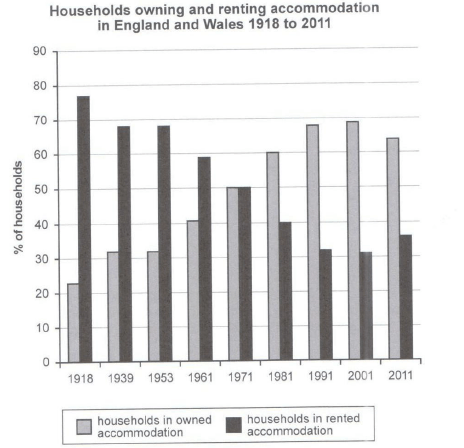
The chart below shows the percentage of households in owned and rented accommodation in England and Wales between 1918 and 2011.
Summarize the information by selecting and reporting the main features and make comparisons where relevant.
Student answer (Band 5.5)
The bar graph compares the percentage of owned and rented accommodation between England and Wales through out the years 1918 and 2011.
Overall, the percentage of renting houses was high from the year 1918 to 1961 and both stayed constant with 50% by 1971, Although, owning property decreased by the years from 1981 to 2011.
On the one hand, In 1981, owned property was only 24% and rented accommodation was at the peak of graph with the percentage of approximately 77%. From 1939 to 1953, both trends were at the similar position like owned land was at 33% and rented houses 68% in both years. In next few years, rented houses were most chosen way of living. In 1971, this trend stayed stable with the 50% through the year.
On the other hand, owning a house got popularity from 1981 and it rose to 60% in contrast rented houses were at 40%. There was a huge increase in home ownership, went up from 67% in 1991, 68% in 2001 and 65% in 2011. However, people living in rented accommodation fell dramatically.(181 words)
AI examiner evaluation
| Criterion | Band |
|---|---|
| Task Achievement / Task Response | 4.5 |
| Coherence and Cohesion | 5.0 |
| Lexical Resource | 6.0 |
| Grammatical Range and Accuracy | 5.5 |
| Overall | 5.5 |
Task Achievement / Task Response: Band 4.5
The response identifies the broad contrast between ownership and renting and notes the equal 50% figures in 1971, but the account of the main trends is substantially inaccurate. The overview says renting remained high only until 1961 and that ownership decreased from 1981 to 2011; in fact, ownership rose to a peak of about 69% in 2001 before falling slightly, while renting followed the reverse pattern. The 1981 figures are also misreported: ownership was about 60%, not 24%, and renting was about 40%, not 77%. Later figures are confused too, with ownership at roughly 68–69% in 1991 and 2001, then 64% in 2011. Select the key turning points and report them accurately to make the summary more complete and reliable.
Coherence and Cohesion: Band 5.0
There is a recognisable paragraph structure, with an introduction, an overview and two body paragraphs, and phrases such as “On the one hand” and “On the other hand” signal a contrast. However, the progression is difficult to follow because the first body paragraph begins with 1981, then jumps back to 1939–1953 and forward to 1971. The overview also conflicts with the later account of ownership rising after 1981, so the links between the main points are unclear. Some connectors, including “Although” after a comma and “In next few years,” do not establish the intended relationship smoothly. Organise the figures chronologically, group the two series together at each stage, and ensure the overview agrees with the details.
Lexical Resource: Band 6.0
The response uses an adequate range of vocabulary for describing the chart, including “percentage,” “peak,” “rose,” “fell,” and “in contrast.” These choices make the general subject understandable, and there is some attempt to vary expressions for ownership and renting. However, several phrases are imprecise or unnatural for a data report: “renting houses,” “most chosen way of living,” and “got popularity” do not describe the chart as clearly as standard terms such as “rented accommodation” or “home ownership increased.” “Huge increase” also overstates the relatively gradual rise shown. Use precise chart language consistently and avoid conversational or evaluative wording; this would improve accuracy and collocational control.
Grammatical Range and Accuracy: Band 5.5
The response includes both simple statements and attempts at more complex structures, for example, “There was a huge increase in home ownership, went up from…” and “Although, owning property decreased…”. Meaning is generally recoverable, but some sentence construction and punctuation errors make relationships unclear. The clause after “There was a huge increase” is not grammatically connected; it could be revised as “Home ownership rose from…”. “Although” is incorrectly used as a sentence connector in the overview, and “both stayed constant with 50%” has an unclear subject and awkward structure. There are also inconsistent capital letters after commas and missing articles in phrases such as “in next few years.” Build complex sentences with complete clauses, and check punctuation, articles and agreement.
See this exact question answered at other band scores. The same prompt compared across bands.
Browse more IELTS Writing model answers or get your own writing scored by the same AI examiner.