Band 6.0 IELTS Writing Task 1 Model Answer
Overall Band Score: 6.0 · Cambridge IELTS 13 · 2026-11-27
IELTS Writing Task 1 question
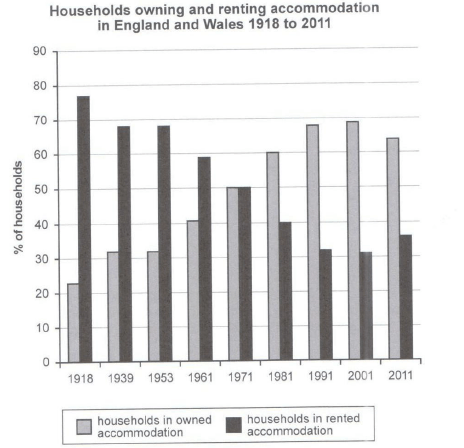
The chart below shows the percentage of households in owned and rented accommodation in England and Wales between 1918 and 2011.
Summarize the information by selecting and reporting the main features and make comparisons where relevant.
Student answer (Band 6.0)
The bar chart comperes the proportion of people lived in rented or owned accommodaion in England and Walesn from 1918 to 2011.
Overall, in between 1918 and 2011, the percentage of owned accommodation increases, while percentage of rented accommodation decreases. However, owned places to stay were less at the start and rented were high but at the end owned becomes high and rented becomes lowest.
In 1918, the percentage of people living in their own houses in England and Wales were about 22 before experiencing a gradual increase from about 22% to almost 70% in 2001. In the period of 1971 and 1981, people living in their own houses overtook the the people living in rented houses in terms of percentage and becomes the highest.
On the other hand, percentage of people living in rented houses decreases from the top and stops at almost 31% in 2001, after that it rose constantly and reached at approximately 36% in 2011.
AI examiner evaluation
| Criterion | Band |
|---|---|
| Task Achievement / Task Response | 6.0 |
| Coherence and Cohesion | 6.0 |
| Lexical Resource | 5.5 |
| Grammatical Range and Accuracy | 5.5 |
| Overall | 6.0 |
Task Achievement / Task Response: Band 6.0
You identify the chart’s main contrast: ownership generally rises while renting falls, and you note the reversal around the middle of the period. The figures you give for ownership in 1918 and renting in 2001 and 2011 are broadly accurate. However, the overview is not fully precise: ownership does not finish at its highest level, since it falls from about 69% in 2001 to 64% in 2011, while renting rises. The statement that ownership overtook renting “in the period of 1971 and 1981” is also vague; the two categories are equal in 1971 and ownership is higher by 1981. Include the key plateau in 1939–1953 and the 2011 reversal to make the main stages clearer.
Coherence and Cohesion: Band 6.0
The response has a clear overall arrangement, moving from an introduction and overview to ownership and then renting. This makes the broad comparison easy to follow. Linking phrases such as “Overall,” “On the other hand,” and “after that” help signal the direction of the discussion. Some connections are less clear or repetitive, however. The overview says rented accommodation “becomes lowest,” which is imprecise, and the ownership paragraph repeats the rise already stated in the overview without adding much detail about the intermediate years. The phrase “In the period of 1971 and 1981” also makes the timing of the crossover unclear. Organise the body around the shared turning point and the later peak and reversal, using references that clearly identify each period.
Lexical Resource: Band 5.5
You use relevant chart vocabulary, including “percentage,” “gradual increase,” “decreases,” and “reached,” so the main trends are generally understandable. There are also attempts at varied phrasing, such as “overtook” and “stops at.” However, several spelling errors and awkward or imprecise collocations reduce control: “comperes,” “accommodaion,” and “Walesn” are misspelled, while “people lived in rented or owned accommodation” and “owned places to stay” are not natural ways to describe the chart’s categories. “Stops at” is also less suitable for a trend that reaches a low point. Use consistent terms such as “households in owner-occupied accommodation” and “the proportion renting,” and check spelling and collocation carefully.
Grammatical Range and Accuracy: Band 5.5
You attempt both simple and more complex sentence forms, and the overall meaning is usually clear. For example, the overview uses a contrast clause beginning “while,” and the final sentence combines a decline with a later rise. Some grammatical errors remain, particularly with agreement, articles, and verb forms. In “the percentage … were about 22,” the singular subject requires “was”; “the percentage of owned accommodation increases” needs an article or a more natural subject construction; and “becomes the highest” should be in the past tense to match the historical data. The phrase “the the people” also contains a repeated article. Review subject–verb agreement and maintain consistent past-tense reporting, while varying sentence structures without sacrificing accuracy.
See this exact question answered at other band scores. The same prompt compared across bands.
Browse more IELTS Writing model answers or get your own writing scored by the same AI examiner.