Band 6.0 IELTS Writing Task 1 Model Answer
Overall Band Score: 6.0 · Cambridge IELTS 13 · 2026-11-27
IELTS Writing Task 1 question
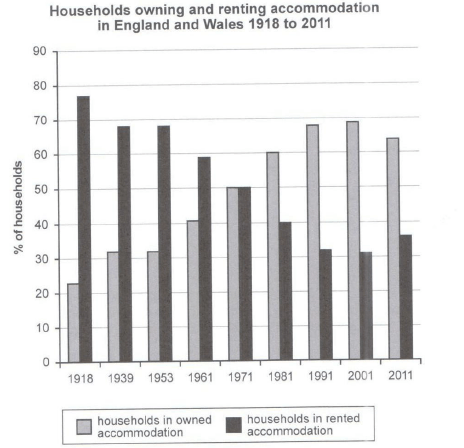
The chart below shows the percentage of households in owned and rented accommodation in England and Wales between 1918 and 2011.
Summarize the information by selecting and reporting the main features and make comparisons where relevant.
Student answer (Band 6.0)
The bar chart describes the proportion of households in ownership and rented accommodation in England and Wales between 1918 and 2011.
Overall, percentage of owned properties have increased with time, whereas rented houses have decreased respectively. The year 1971, was the point where rented and owned households met at a equal percentage.
In Eangland and Wales from 1918 to 2011, owned accommodation have increased. At the starting year 1918 the ownerships houses were at above 20%, which kept on rising till it reached to 50% in 1971. This was the only year where rented properties match the proportion of owned accommodations. In 2001, ownership accommodation touched its heighest point nearly 70% then it fell down for the first time in 2011 and ended up around 65% of owned properties.
Households in rented accommodation in England and Wales in 1918 was at its peak, close to 80% of the households were rented in that year. It fell below 70% in 1938 and stayed steady till 1953. After that it kept on decreasing till it match the pencentage of ownen houses in 1971. As time went it fell more and and more till it reached to its lowest percentage above 30%. In 2011, for the first time it rose up and went at approximately 35%.
AI examiner evaluation
| Criterion | Band |
|---|---|
| Task Achievement / Task Response | 7.0 |
| Coherence and Cohesion | 6.5 |
| Lexical Resource | 5.5 |
| Grammatical Range and Accuracy | 5.5 |
| Overall | 6.0 |
Task Achievement / Task Response: Band 7.0
The response identifies the chart’s main contrast and gives a clear overview: ownership generally rose while renting declined, and the two figures met in 1971. It also selects the key turning points, including ownership peaking at about 69% in 2001 before falling, and renting rising again by 2011. These details support the main trends well. There are, however, a couple of small factual imprecisions: renting fell below 70% in 1939, not 1938, and the final ownership figure is closer to 64% than 65%, though this is a minor approximation. To strengthen the report further, describe the flat periods in both series more precisely and avoid broad wording such as “kept on rising” where the figures were unchanged between 1939 and 1953.
Coherence and Cohesion: Band 6.5
The response is organised into an introduction, an overview, and separate paragraphs for ownership and renting, so the reader can follow the two series and their comparison. Time markers such as “At the starting year,” “In 2001,” and “After that” help establish progression. This is a coherent overall arrangement, but some linking is repetitive or imprecise: “kept on rising” and “kept on decreasing” recur, while “As time went” is an awkward transition. The overview’s “respectively” does not clearly connect the two trends, and the final paragraph’s repeated “and and” interrupts flow. Use more varied, accurate transitions and make references between the series explicit to achieve smoother cohesion.
Lexical Resource: Band 5.5
The response uses a relevant range of chart vocabulary, including “proportion,” “accommodation,” “peak,” “steady,” and “lowest percentage,” which makes the main trends understandable. However, several word choices and collocations are inaccurate or unnatural, limiting precision: “ownerships houses,” “ownership accommodation,” “match the percentage,” and “went at approximately 35%.” There are also noticeable spelling errors, including “Eangland,” “heighest,” and “pencentage,” as well as the incorrect form “ownen.” Aim for standard expressions such as “the proportion of households that owned their homes,” “equalled,” and “rose to.” More accurate collocations and careful proofreading would make the description clearer and more natural.
Grammatical Range and Accuracy: Band 5.5
The response attempts both simple and more extended sentence forms, including clauses with “whereas,” “which,” and “then,” and the overall meaning remains clear. However, errors in agreement, articles, and verb forms occur repeatedly. For example, “percentage of owned properties have increased” needs a singular subject and a more suitable verb form; “rented accommodation … was” conflicts with the plural idea of households; and “at a equal percentage” has an article error. The sentence “In 2001, ownership accommodation touched its heighest point … then it fell” also joins two independent clauses without suitable punctuation or a connector. Check subject–verb agreement, articles, and sentence boundaries, while retaining the range of structures attempted.
See this exact question answered at other band scores. The same prompt compared across bands.
Browse more IELTS Writing model answers or get your own writing scored by the same AI examiner.