Band 6.5 IELTS Writing Task 1 Model Answer
Overall Band Score: 6.5 · Cambridge IELTS 13 · 2026-11-28
IELTS Writing Task 1 question
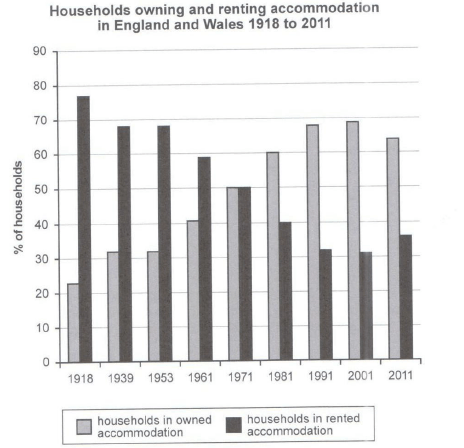
The chart below shows the percentage of households in owned and rented accommodation in England and Wales between 1918 and 2011.
Summarize the information by selecting and reporting the main features and make comparisons where relevant.
Student answer (Band 6.5)
The bar chats illustrates the percentage of households living in owned and rented accommodation in England and Wales between 1918 and 2011.
Overall, it is clear that the percentage of owns accomodation increased significantly over the period. While the percentage of rented accommodation decreased. In 1971, both categories had an equal percentage.
In 1918, approximately 22% of households owned their homes, whereas around 78% lived in rented accommodation. In 1939 and 1953, the percentage of owned homes increased to 32% and rented accommodation percentage decreased to 68%. In 1961, the percentage of homeowners had risen to around 42%, compared with 58% of rented households. In 1971, both owned and rented accommodation accounted for 50% of households. After that, home ownership countinued t increase, reaching approximately 60% in 1981 and 68% in 1991.
It reached its highest point at around 69% in 2001 before falling slightly to 65% in 2011. In contrast, renting showed the opposite trend. It declined to around 40% in 1981 and reached its lowest level of approximately 31% in 2001. However, it increased slightly to around 35% in 2011.
AI examiner evaluation
| Criterion | Band |
|---|---|
| Task Achievement / Task Response | 7.0 |
| Coherence and Cohesion | 6.5 |
| Lexical Resource | 6.0 |
| Grammatical Range and Accuracy | 6.0 |
| Overall | 6.5 |
Task Achievement / Task Response: Band 7.0
You provide a clear overview of the main pattern: ownership generally rose, renting generally fell, and the two were equal in 1971. The key figures are accurately represented, including the peak in ownership in 2001 and its subsequent decline, alongside the small rise in renting by 2011. This gives the reader a well-supported account of the chart’s main stages. The overview could be slightly more precise by noting that ownership levels were unchanged between 1939 and 1953, and that the two series move in opposite directions overall. Still, the response selects relevant comparisons and supports them with appropriate data, while avoiding unsupported claims.
Coherence and Cohesion: Band 6.5
The response is organised effectively into an introduction, an overview, and two paragraphs of supporting details. The chronological progression makes the figures easy to follow, and links such as “whereas,” “After that,” and “In contrast” help signal comparisons and changes. This is a coherent overall arrangement. To make the progression more seamless, avoid the sentence fragment “While the percentage of rented accommodation decreased,” which interrupts the overview, and connect the final ownership and renting details more deliberately. Some transitions are also quite formulaic; varying how you group the early and later periods would show more flexible cohesion while retaining the clear structure already present.
Lexical Resource: Band 6.0
You use an adequate range of chart vocabulary, including “increased,” “decreased,” “reaching,” “highest point,” and “declined,” and the contrast between ownership and renting is generally clear. However, some word choices and collocations are inaccurate or awkward: “bar chats” should be “bar chart,” “percentage of owns accomodation” is not a natural phrase, and “home ownership countinued” contains spelling errors. “Home ownership” or “households owning their homes” would be more precise than “homeowners” when describing a percentage of households. These slips do not prevent understanding, but careful proofreading and more consistent use of accurate chart terminology would improve control and precision.
Grammatical Range and Accuracy: Band 6.0
You use a mix of simple and more complex sentence forms, including comparisons with “whereas” and “compared with,” and most of the data descriptions are understandable. Some grammatical errors remain. The overview contains a fragment: “While the percentage of rented accommodation decreased,” which needs to be joined to the preceding sentence or completed. In “the percentage of owns accomodation,” the noun phrase is not grammatically formed; use “the percentage of households owning accommodation.” The phrase “continued t increase” also needs the infinitive “to increase.” These errors are limited and meaning is generally clear, but checking sentence completeness and the structure of noun phrases would make the writing more accurate.
See this exact question answered at other band scores. The same prompt compared across bands.
Browse more IELTS Writing model answers or get your own writing scored by the same AI examiner.