Band 5.5 IELTS Writing Task 1 Model Answer
Overall Band Score: 5.5 · Cambridge IELTS 13 · 2026-11-06
IELTS Writing Task 1 question
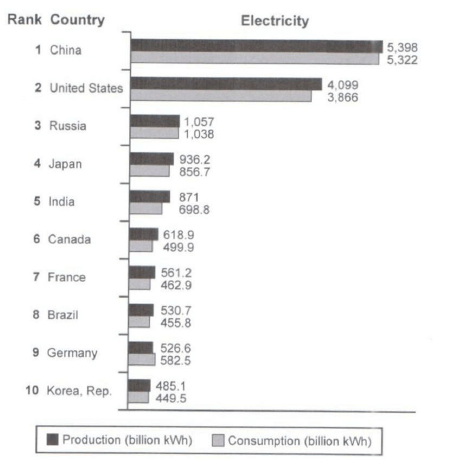
The bar chart below shows the top ten countries for the production and consumption of electricity in 2014.
Summarize the information by selecting and reporting the main features, and make comparisons where relevant.
Student answer (Band 5.5)
The bar chart below compares the top ten countries in order to produce and utilize the electricity in 2014. Overall, most of the electricity produced and consumed by China and United States. However, other countries contained almost the same proportion of the electricity, in both producing and utilizing while Korea hold the minor proportion as compared to other countries.
Initially, we can see that China was the most electricity making and the exploiting country from all over the world during 2014, followed by United States as a second place in the list, in the same year. Surprisingly, there was a huge difference after these countries, owing to that Russia, Japan and India were the countries with very low production and utilization of electricity, even less than half of the first two countries.
On the other hand, remaining countries such as Canada, France, Brazil and Germany also had minor proportion in making and the consuming of the electricity in 2014. Nevertheless, Korea was lowest ranked country in the production and consumption of electricity in the same year.
AI examiner evaluation
| Criterion | Band |
|---|---|
| Task Achievement / Task Response | 5.5 |
| Coherence and Cohesion | 6.0 |
| Lexical Resource | 5.5 |
| Grammatical Range and Accuracy | 5.5 |
| Overall | 5.5 |
Task Achievement / Task Response: Band 5.5
You identify the main leaders and the broad pattern: China and the United States are far ahead, while Korea has the lowest production and consumption. However, the overview is not fully accurate: the other countries do not all have “almost the same proportion,” and Germany’s consumption (582.5 billion kWh) exceeds its production, unlike the pattern implied for the remaining countries. The comparison that Russia, Japan and India are “less than half” of the first two is also imprecise, since Russia is below half of the US figures but Japan and India are much lower. To strengthen the response, report key figures and make clearer comparisons across the middle-ranked countries, including Germany’s exception.
Coherence and Cohesion: Band 6.0
The response has a clear three-paragraph structure, moving from an overview to the leading countries and then the lower-ranked group. Linking phrases such as “Overall,” “Initially,” and “On the other hand” help signal this progression. However, some connections are mechanical or do not accurately express the relationship between ideas: “On the other hand” introduces another group rather than a contrast, and “Surprisingly” does not lead to a clearly explained surprise. The grouping of Russia, Japan and India with the same broad description also makes the comparison less precise. Use transitions that reflect the actual data, and organise the body around meaningful comparisons, such as the two leaders, the middle group, and the lowest figures.
Lexical Resource: Band 5.5
You use a reasonable range of vocabulary related to the topic, including “production,” “consumption,” “proportion,” and “ranked.” However, several choices are inaccurate or unnatural, which limits precision: “electricity making,” “exploiting the electricity,” and “contained almost the same proportion” do not express the intended chart comparisons clearly. “Minor proportion” is also less suitable than language describing output or consumption levels. Aim for standard collocations used in data reporting, such as “generated,” “consumed,” “accounted for,” and “recorded the lowest figures.” This would make your descriptions more natural and help distinguish between production and consumption without relying on repeated general terms.
Grammatical Range and Accuracy: Band 5.5
You attempt a mix of simple and more complex sentences, including a subordinate clause with “owing to” and a contrast introduced by “while.” Meaning is generally understandable, but some sentence structures and agreement patterns are inaccurate. For example, “most of the electricity produced and consumed by China and United States” lacks a finite verb, while “Korea hold” has incorrect subject–verb agreement. Articles are also missing in “United States” and “lowest ranked country.” The sentence beginning “Surprisingly” is awkwardly constructed, making the comparison difficult to follow. Practise complete overview sentences with a clear subject and verb, and check articles, agreement, and punctuation when combining clauses.
See this exact question answered at other band scores. The same prompt compared across bands.
Browse more IELTS Writing model answers or get your own writing scored by the same AI examiner.