Band 6.0 IELTS Writing Task 1 Model Answer
Overall Band Score: 6.0 · Cambridge IELTS 13 · 2026-11-06
IELTS Writing Task 1 question
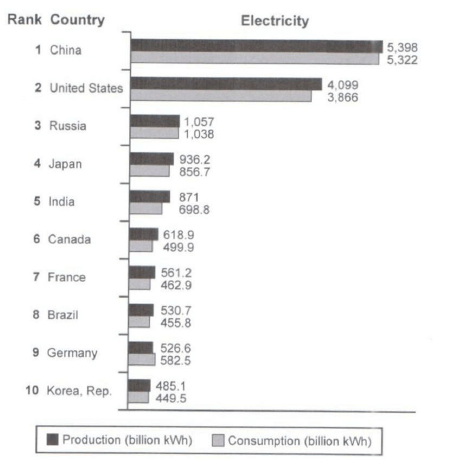
The bar chart below shows the top ten countries for the production and consumption of electricity in 2014.
Summarize the information by selecting and reporting the main features, and make comparisons where relevant.
Student answer (Band 6.0)
The below chart illustrates the rankings of top ten countries that consumption and production of electricity in the year 2014. Now we will compare the main featuresof the data given in this chart.
At first we can clearly see that China is the leading in both making and usage of current that is 5,398 and 5,322 (billion kWh) and the Unitied States is next country that close to China with 4,099 and 3,866. While coming to the remaining countries they recorded very less numbers compared to both China and United States.
Russia produce and consume 1,057 and 1,038 billion kWh, Japan with 936.2 and 856.7, Indian records with 871 and 698.8, Canada 618.9 and 499.9, France is 561.2 and 462.9, Brazil 530.7 and 455.8, Germany with 526.6 and 582.5, and Least numbers were recorded by Korea Republic with production and consume 449.5.
Overall all most all the countries consuming less electricity than what they produce and while Germany is the only country with consumpion is more than the production.
AI examiner evaluation
| Criterion | Band |
|---|---|
| Task Achievement / Task Response | 6.0 |
| Coherence and Cohesion | 6.5 |
| Lexical Resource | 5.5 |
| Grammatical Range and Accuracy | 5.0 |
| Overall | 6.0 |
Task Achievement / Task Response: Band 6.0
You identify the main pattern accurately: China and the United States lead both measures by a wide margin, and Germany is the exception where consumption exceeds production. Most figures you include match the chart, including the values for the first eight countries. However, the final comparison is incomplete: Korea’s production is 485.1, but you give 449.5, which is its consumption, and you do not report both figures. The overview also appears only at the end, while the opening mainly announces that you will compare the chart. To strengthen the response, state the key contrasts clearly in an overview near the beginning and select a few figures to support them, rather than listing nearly every country without further comparison.
Coherence and Cohesion: Band 6.5
The response has a generally understandable order: an introduction, a sequence of country figures, and a concluding overview. The final sentence effectively highlights the broad production–consumption pattern, and the country-by-country sequence helps readers follow the data. This organisation is coherent, though the progression is not always smooth: “At first” and “While coming to” sound mechanical, and the long middle sentence strings together many figures with limited grouping. The overview would be more effective as a distinct paragraph near the start, followed by comparisons grouped by scale or pattern. Use linking phrases selectively and make references such as “both” or “the remaining countries” precise so the relationships between figures are easier to track.
Lexical Resource: Band 5.5
You use relevant vocabulary for describing the chart, including “leading,” “recorded,” “production,” and “consuming,” so the main information remains understandable. However, the range and precision are limited by informal or inaccurate choices such as “making and usage of current,” “very less numbers,” and “close to China.” Some expressions are also awkwardly formed, including “the leading in both” and “Least numbers were recorded.” These choices make the report less natural and occasionally obscure the intended meaning. Aim for standard data-reporting collocations and use the chart’s terms consistently, such as “electricity production,” “electricity consumption,” “generated,” and “ranked second.” Check spelling as well, particularly “consumption.”
Grammatical Range and Accuracy: Band 5.0
You attempt both simple statements and longer sentences, and the main comparisons can generally be understood. However, control is uneven, especially in longer constructions. For example, “China is the leading in both…” has an article and structure problem, while “Russia produce and consume” does not maintain correct subject–verb agreement. The sentence beginning “While coming to the remaining countries” is also not a complete, natural clause, and the final sentence has an unclear construction around “while Germany is.” Use straightforward comparative sentence patterns first, such as “China produced X and consumed Y,” then add complex clauses only when their grammar is secure. Review articles, verb agreement, and sentence boundaries.
See this exact question answered at other band scores. The same prompt compared across bands.
Browse more IELTS Writing model answers or get your own writing scored by the same AI examiner.