Band 6.5 IELTS Writing Task 1 Model Answer
Overall Band Score: 6.5 · Cambridge IELTS 13 · 2026-11-08
IELTS Writing Task 1 question
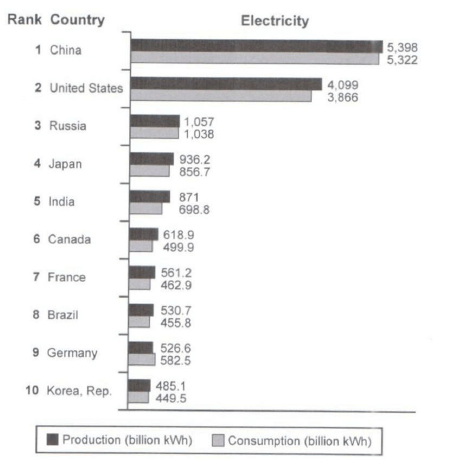
The bar chart below shows the top ten countries for the production and consumption of electricity in 2014.
Summarize the information by selecting and reporting the main features, and make comparisons where relevant.
Student answer (Band 6.5)
The given bar chart illustrates the electricity production and usage of top ten countries in 2014.
Overall, all the countries have produced more than the consumption except Germany. Among all the nations China and the United States have produced and used significantly more than others.
China Produced 5298 billion kWh and they consumed nearly the same amount. The United States has roughly produced 1000 billion kWh less than China and used 1500 billion kWh less than them. Russia only produced one-fifth of electricity compared to China and they consumed 1038 billion kWh, which is only 19 billion kWh less than they produced.
India produced 936.2 billion kWh and they only used 698.8 billion kWh, which is approximately 150 less than they produced. Canada, France and Brazil produced over 500 billion kWh electricity and used less than they generated. However, German consumed more than they generated. They produced 526.6 billion kWh and used 582.5 billion kWh. It is roughly 50 billion kWh more than they generate.
AI examiner evaluation
| Criterion | Band |
|---|---|
| Task Achievement / Task Response | 6.5 |
| Coherence and Cohesion | 6.0 |
| Lexical Resource | 6.5 |
| Grammatical Range and Accuracy | 6.0 |
| Overall | 6.5 |
Task Achievement / Task Response: Band 6.5
You provide a relevant overview, identifying China and the United States as the clear leaders and noting that Germany is the exception to the general pattern of production exceeding consumption. Several comparisons are also supported with figures. However, there are important inaccuracies: China produced 5,398 billion kWh, not 5,298, and the United States produced about 1,300 billion less than China and consumed about 1,456 billion less, rather than the stated differences. India’s production is given as 936.2, which is Japan’s figure; India produced 871. The response also omits useful comparisons for Japan and Korea. The overview is sound, but more accurate reporting and fuller coverage would make the account more complete and precise.
Coherence and Cohesion: Band 6.0
The response has a clear overall arrangement: an introduction, an overview, and two paragraphs of supporting details. The progression from the leading countries to the remaining figures is generally easy to follow, and linking words such as “Overall,” “However,” and “which” help connect ideas. Some grouping is less effective, though: the final paragraph moves from India to three countries grouped together, then to Germany, without a clear comparison of the middle-ranking countries. References such as “they” and “them” are also repeated and can be unclear when several countries are discussed. Organising the details into clearer groups and using more precise references would strengthen the flow.
Lexical Resource: Band 6.5
You use an adequate range of task-related vocabulary, including “production,” “consumption,” “generated,” “roughly,” and “approximately.” These choices make the main comparisons understandable, and “significantly more” effectively describes the gap between the two leading countries and the rest. Some wording is imprecise or repetitive: “used” appears where “consumed” would be more formal and consistent, while “produced and used significantly more” is a broad description that could be expressed more precisely. “Produced over 500 billion kWh electricity” also has an awkward collocation. Greater consistency in terminology and more exact comparison phrases would improve the precision and flexibility of the vocabulary.
Grammatical Range and Accuracy: Band 6.0
You use a mix of simple and complex sentence forms, including clauses with “which” and “except,” and most sentences communicate their meaning clearly. Some grammatical errors remain. For example, “China Produced” has an unnecessary capital letter, and “German consumed” uses the wrong form of the country name; the sentence should refer to “Germany.” Tense and agreement are not always consistent, as in “all the countries have produced” followed by “China Produced,” and “It is roughly 50 billion … more than they generate.” The pronoun “they” also does not agree clearly with singular country names. More consistent past-tense reporting and careful checking of agreement and sentence punctuation would improve accuracy.
See this exact question answered at other band scores. The same prompt compared across bands.
Browse more IELTS Writing model answers or get your own writing scored by the same AI examiner.