Band 5.5 IELTS Writing Task 1 Model Answer
Overall Band Score: 5.5 · Cambridge IELTS 13 · 2026-11-09
IELTS Writing Task 1 question
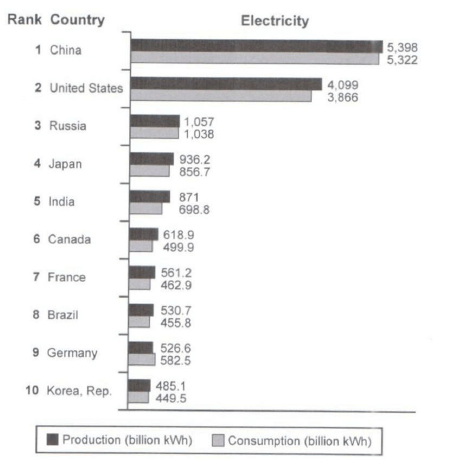
The bar chart below shows the top ten countries for the production and consumption of electricity in 2014.
Summarize the information by selecting and reporting the main features, and make comparisons where relevant.
Student answer (Band 5.5)
We are looking at an old chart of most 10 countries that produce and consume electrecity in 2014 which is 12 years ago, the chart is ranking the most countries used to electricity aswell as produced from top which is 5389 billion kwh as a produced electricity and 5322 billion kwh consumed for china and that's make sense making it the highest with usa as second and all that because the high amound of population and factories in those countries then we got the lowest in this top tier 10 which is korea republic for 485 production and 449 consumption and that's too low compared to those manifactured countries other than that we can also see all those countries in top 10 have statisfied amound of production compared with consumption and that's mean these countries have achieved self-sufficiency in terms of electricity except germany which consume more than it's produce.
AI examiner evaluation
| Criterion | Band |
|---|---|
| Task Achievement / Task Response | 5.5 |
| Coherence and Cohesion | 5.0 |
| Lexical Resource | 5.5 |
| Grammatical Range and Accuracy | 5.0 |
| Overall | 5.5 |
Task Achievement / Task Response: Band 5.5
You identify the chart’s main extremes: China is the largest producer and consumer, while South Korea is the smallest among the ten. You also note the important exception that Germany consumes more electricity than it produces. However, the response does not give a clear, balanced overview of the overall pattern, and several comparisons are asserted rather than accurately reported. For example, China’s production is 5,398 billion kWh, not 5,389, and the United States is second, but the response gives little detail about the substantial gap between these two countries and the remaining nations. The explanation about population and factories is not shown by the chart. Focus on the data, summarise the main pattern, and support it with accurate comparisons.
Coherence and Cohesion: Band 5.0
The response contains a recognisable sequence, moving from China and the United States to the lowest-ranked country and then to the production–consumption comparison. This gives the reader some sense of the information being discussed. However, it is presented as one long sentence, with ideas joined mainly by “and,” “then,” and “other than that.” As a result, the progression is difficult to follow and relationships between points are not always clear. Organise the report into short paragraphs, such as an overview followed by key comparisons, and use linking expressions selectively. Clear sentence boundaries would also help distinguish chart observations from your explanation about population and factories.
Lexical Resource: Band 5.5
You use some relevant chart vocabulary, including “ranking,” “production,” “consumption,” and “self-sufficiency,” and the reader can generally identify the countries and measures you mean. However, the range is limited and several word choices or collocations are inaccurate, such as “most 10 countries,” “used to electricity,” and “satisfied amount of production.” Spelling errors, including “electrecity,” “amound,” and “manifactured,” also reduce clarity and control. Choose precise, conventional terms for describing data, such as “the top ten countries,” “electricity consumption,” and “production exceeded consumption.” Avoid informal or unsupported descriptions such as “that’s too low” in an academic report.
Grammatical Range and Accuracy: Band 5.0
The response attempts to connect several ideas using clauses, including the comparison that Germany “consume more than it's produce,” but the sentence structures are often faulty and the long run-on sentence makes meaning harder to follow. There are recurring problems with subject–verb agreement (“Germany … consume”), verb forms (“it's produce”), articles and sentence construction (“as a produced electricity”), as well as punctuation and capitalisation. These errors sometimes obscure the intended relationships between ideas. Use shorter sentences with one main comparison in each, and check agreement and verb forms—for example, “Germany consumes more electricity than it produces.” A wider range of accurately controlled sentence patterns is needed.
See this exact question answered at other band scores. The same prompt compared across bands.
Browse more IELTS Writing model answers or get your own writing scored by the same AI examiner.