Band 5.5 IELTS Writing Task 1 Model Answer
Overall Band Score: 5.5 · Cambridge IELTS 13 · 2026-11-09
IELTS Writing Task 1 question
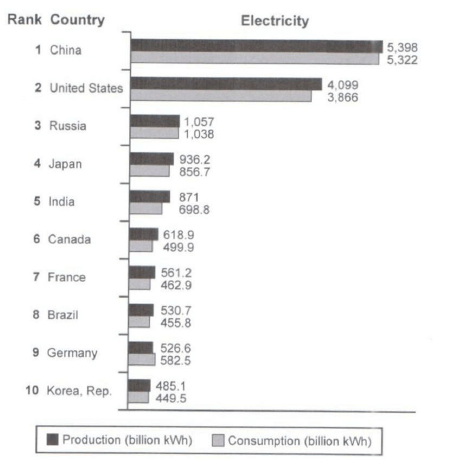
The bar chart below shows the top ten countries for the production and consumption of electricity in 2014.
Summarize the information by selecting and reporting the main features, and make comparisons where relevant.
Student answer (Band 5.5)
The bar chart illustrates the top ten countries for the production and consumption of electricity in 2014.
Overall, it is evident that China had the highest proportion, whereas Korea (Rep) recorded the lowest figure. Another notable feature is that Russia, Japan, India, Canada, France, Brazil and Germany shows lesser proportion than China and United States.
Looking first at the highest figures, China accounted for 5,398 billion kWh production and 5,322 kWh consumption which was nearly same. This was followed by United States, at 4,099 kWh production and 3,866 KWH consumption of electricity. Meanwhile Russia represented 1,057 kWh production and 1,038 kWh consumption which was higher than Japan with 936.2 kWh production and 856 kWh consumption.
In contrast India, Canada, France, Brazil, and Germany showed considerably lower proportion ranging between 871 to 526 kWh in terms of production and 698 to 582 kWh in consumption. However, Korea, Rep accounted for the lowest production and consumption that is 485 kWh and 449.5 kWh respectively.
AI examiner evaluation
| Criterion | Band |
|---|---|
| Task Achievement / Task Response | 5.5 |
| Coherence and Cohesion | 6.0 |
| Lexical Resource | 5.5 |
| Grammatical Range and Accuracy | 5.5 |
| Overall | 5.5 |
Task Achievement / Task Response: Band 5.5
You identify the main extremes accurately: China is highest and Korea lowest, and you compare the two leading countries with Russia and Japan. However, the overview is partly imprecise: saying the other listed countries have lower figures than China and the United States is true but does not highlight the more useful pattern that there is a large gap after the US. Some figures are incomplete or inaccurate, including Japan’s consumption (856.7, not 856) and the broad ranges for the lower-ranked countries, which overlook Germany’s consumption exceeding its production. The response also falls one word short of the 150-word minimum; the 13 words copied from the task prompt were not counted. Add a clearer overview and report key exceptions and comparisons more precisely.
Coherence and Cohesion: Band 6.0
The response has a clear overall arrangement: an introduction and overview are followed by paragraphs comparing the higher and lower figures. Sequencing phrases such as “Looking first” and “In contrast” help guide the reader through the data. However, the overview’s second sentence lists seven countries without explaining a meaningful pattern, and the final paragraph groups several countries together in a broad range, making the comparisons less clear. “However” before the Korea figures does not express a strong contrast with the preceding information. Improve progression by grouping countries according to their output levels and using links that accurately show comparison or exception; for example, Germany’s consumption is an exception to the general pattern of production being higher.
Lexical Resource: Band 5.5
You use relevant chart vocabulary, including “production,” “consumption,” “accounted for,” and “recorded,” and the meaning is generally understandable. However, some choices are repetitive or imprecise: “proportion” is not suitable for these absolute electricity figures, and “lesser proportion” is awkward. “Nearly same” and “showed considerably lower proportion” also lack natural collocation. Use terms such as “amount,” “figure,” “output,” and “consumption level,” and vary comparisons with phrases like “stood at” or “was substantially lower.” Take care with unit presentation too: the chart gives both series in billion kWh, so state the unit consistently rather than attaching it inconsistently to individual figures.
Grammatical Range and Accuracy: Band 5.5
You attempt a mix of simple and more complex sentences, including clauses introduced by “whereas” and “which,” and most of the comparisons remain understandable. Some grammatical errors are noticeable, however. In “Russia, Japan, India, Canada, France, Brazil and Germany shows,” the plural subject requires “show.” The phrase “which was nearly same” needs an article and a more complete construction, such as “which were nearly the same.” In “China accounted for 5,398 billion kWh production,” the noun phrase needs a grammatical link, for example “production of 5,398 billion kWh.” Review subject–verb agreement, articles, and sentence construction around figures to make these comparisons more accurate.
See this exact question answered at other band scores. The same prompt compared across bands.
Browse more IELTS Writing model answers or get your own writing scored by the same AI examiner.