Band 6.0 IELTS Writing Task 1 Model Answer
Overall Band Score: 6.0 · Cambridge IELTS 13 · 2026-11-11
IELTS Writing Task 1 question
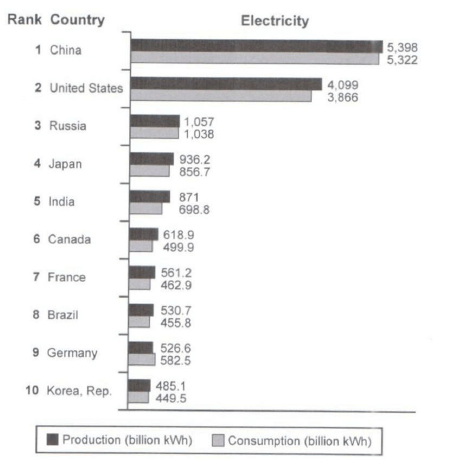
The bar chart below shows the top ten countries for the production and consumption of electricity in 2014.
Summarize the information by selecting and reporting the main features, and make comparisons where relevant.
Student answer (Band 6.0)
The bar chart illustrates the manufacturing and spending of electricity for the top ten countries in 2014. The unit of measurement is kWh.
Overall, the production of electricity was always high in comparison with the spending of electricity. China was the largest manufacturing and spending country among all the top ten countries whereas South Korea was the lowest producer and spender of electricity.
In 2014, China was the largest manufacturer of electricity, which was 5,398 kWh and the spending was 5,322. United States was the second highest producer of electricity which was 399 kWh less than China. The production and consumption of electricity were respectively 4099 kWh and 3,866 kWh in United States. Apart from China and United States, other countries production and consumption amount of electricity were significantly less.
Germany was the only country who had more spending, than the produced electricity. Russia was the third highest producer and consumer of electricity which were respectively 1,057 kWh and 1,038 kWh. South Korea was the lowest producer and consumer of electricity, which were respectively 485.1 kWh and 449.5 kWh.
AI examiner evaluation
| Criterion | Band |
|---|---|
| Task Achievement / Task Response | 6.5 |
| Coherence and Cohesion | 6.5 |
| Lexical Resource | 5.5 |
| Grammatical Range and Accuracy | 6.0 |
| Overall | 6.0 |
Task Achievement / Task Response: Band 6.5
You identify the main pattern clearly: China and the United States lead by a large margin, while South Korea is lowest, and you note Germany as the exception where consumption exceeds production. The figures you give for China, the United States, Russia and South Korea are accurate, and the overview is relevant. This covers the task well, but some comparisons are less fully developed: for example, you do not report Japan, India or the middle-ranking countries, and the claim that production was “always high in comparison with” consumption overlooks Germany’s higher consumption and could be more precise. To strengthen the response, compare the remaining countries selectively and describe the overall gap between the leading pair and the others more specifically.
Coherence and Cohesion: Band 6.5
The response has a clear overall arrangement, moving from an introduction and overview to details about the leading countries and then the exception and lowest-ranked country. Paragraphing helps distinguish the overview from the data. Linking expressions such as “Overall,” “Apart from,” and “whereas” guide the reader, although some connections feel mechanical or repetitive, particularly the repeated use of “producer and consumer” and “production and consumption.” The sentence about the United States also repeats information already introduced, rather than advancing the comparison. A more deliberate sequence—leaders, middle group, then Germany and South Korea—would make the progression more complete and cohesive, with clearer references between comparisons.
Lexical Resource: Band 5.5
You use a reasonable range of topic vocabulary, including “largest,” “second highest,” “significantly less,” and “respectively,” so the main information is understandable. However, several word choices are inaccurate or unnatural for describing electricity data. “Manufacturing” and “spending” are not suitable substitutes for “production” and “consumption,” and “spending country” suggests money rather than electricity use. The repeated use of “electricity” and “producer and spender” also limits precision. Aim for consistent, accurate chart language and vary it with terms such as “generated,” “used,” and “output.” This would make the vocabulary more natural and precise while retaining the clear meaning of your comparisons.
Grammatical Range and Accuracy: Band 6.0
You use both simple and more complex sentence forms, including a relative clause in “China was the largest manufacturer …, which was 5,398 kWh” and a contrast clause with “whereas.” Most sentences communicate the intended comparisons, but some grammatical errors remain. For example, “other countries production and consumption amount” needs a possessive form and plural agreement, while “the only country who had” uses an unsuitable relative pronoun for a country. The phrase “more spending, than the produced electricity” also has awkward punctuation and an unclear grammatical comparison. Check possessives, agreement, and clause construction, and make sure comparisons use parallel forms, such as “consumption was higher than production.”
See this exact question answered at other band scores. The same prompt compared across bands.
Browse more IELTS Writing model answers or get your own writing scored by the same AI examiner.