Band 5.5 IELTS Writing Task 1 Model Answer
Overall Band Score: 5.5 · Cambridge IELTS 13 · 2026-11-11
IELTS Writing Task 1 question
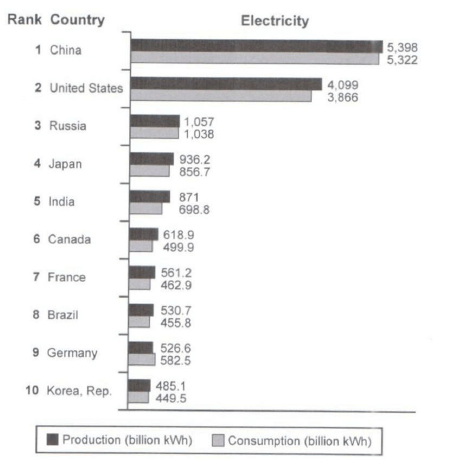
The bar chart below shows the top ten countries for the production and consumption of electricity in 2014.
Summarize the information by selecting and reporting the main features, and make comparisons where relevant.
Student answer (Band 5.5)
The bar chart illustrates the production and consumption of electricity in top ten different countries in 2014 year. The unit is measured in billion kWh.
Overall, china is at the top list for the production and consumption of electricity approximately 5,398 and 5,322 billion kWh whereas korea, rep country manufactured 485.1 billion kWh and utilized 449.5 billion kWh.
US stand on second rank with 4099 billion kWh elcetricity prodction and used 3856 billion kWh. Meanwhile russia and japan assembled 1057 and 936.2 electricity and 1038 , 856.7 expenditured of energy respectively. India produced only 871 and consumped 698.8 electricity.
canada stand with 618.9 billion kWh production and 499.9 comsumption of electricity. In contrast frence and brazil stand with 561.2 ,462.9 530.7 and 455,8 billion kWh electricity. Moreover, germany prodced 526.6 and used 582.5 electrictiy respectively.
AI examiner evaluation
| Criterion | Band |
|---|---|
| Task Achievement / Task Response | 5.0 |
| Coherence and Cohesion | 6.0 |
| Lexical Resource | 5.0 |
| Grammatical Range and Accuracy | 5.0 |
| Overall | 5.5 |
Task Achievement / Task Response: Band 5.0
You identify the chart’s subject and year, and your overview correctly highlights China as the largest producer and consumer and Korea as the smallest producer. You also report several relevant figures, including those for the US, Russia, Japan and India. However, the response only partially fulfils the task: the overview is limited, and the lower-ranked countries are not compared clearly. The US consumption figure is inaccurate: the chart gives 3,866, not 3,856. The France and Brazil figures are also presented in a confusing sequence, making it unclear which values belong to each country. Germany’s consumption exceeding its production is a useful feature, but it is not explained as a notable exception. The response is 15 words below the required minimum; develop the comparisons and overview to address this.
Coherence and Cohesion: Band 6.0
The response has a recognisable structure: an introduction, an overview, and two paragraphs reporting figures. This gives the reader a basic route through the information, and connectors such as “Meanwhile” and “In contrast” show an attempt to link comparisons. However, progression is uneven: the overview focuses on China and Korea, while the later paragraphs move through countries without a clear grouping or consistent comparison. The sentence beginning “In contrast frence and brazil” is especially difficult to follow because several figures are listed without clearly matching each one to its country. Use a more deliberate order, such as grouping the leading producers and then comparing the remaining countries, and make each comparison explicit. This would make the organisation clearer and reduce reliance on mechanical transitions.
Lexical Resource: Band 5.0
You use some relevant task vocabulary, including “production,” “consumption,” “approximately,” and “respectively,” so the topic is generally understandable. However, the range is limited and several word choices or forms are inaccurate or unnatural, sometimes making the data harder to interpret. For example, “assembled” and “expenditured” do not appropriately describe electricity production and consumption, while “used” is less precise than “consumed.” There are also noticeable spelling errors, including “elcetricity,” “prodction,” “comsumption,” and “electrictiy.” Country names should be capitalised and spelled correctly, such as “China,” “Russia,” and “France.” Aim for accurate, repeated use of a small set of suitable terms rather than substituting unfamiliar words that do not fit the context.
Grammatical Range and Accuracy: Band 5.0
You attempt both simple statements and a more complex overview sentence using “whereas,” and most of the intended comparisons can be understood. However, the range of sentence structures is limited, and frequent errors in articles, agreement, tense and sentence construction reduce accuracy. For example, “in top ten different countries” needs an article and a more natural structure, while “US stand on second rank” has an agreement error and an awkward grammatical pattern. In “frence and brazil stand with 561.2, 462.9 530.7 and 455,8,” the punctuation and structure do not clearly connect the figures to the countries. Practise forming complete comparison sentences with consistent past-tense verbs and clear subject–verb agreement, and check punctuation around lists of figures.
See this exact question answered at other band scores. The same prompt compared across bands.
Browse more IELTS Writing model answers or get your own writing scored by the same AI examiner.