Band 5.5 IELTS Writing Task 1 Model Answer
Overall Band Score: 5.5 · Cambridge IELTS 13 · 2026-11-12
IELTS Writing Task 1 question
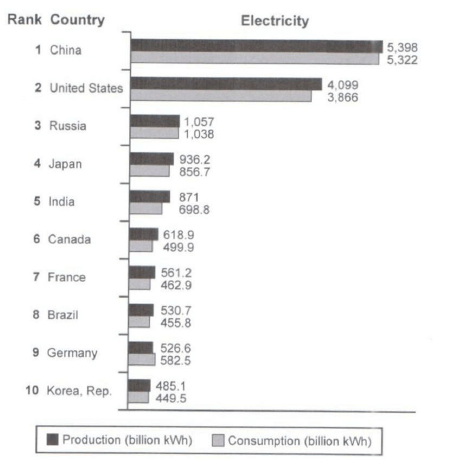
The bar chart below shows the top ten countries for the production and consumption of electricity in 2014.
Summarize the information by selecting and reporting the main features, and make comparisons where relevant.
Student answer (Band 5.5)
This bar graph shows 10 different countries of world and there electricity usage. According to this graph china is leading in electricity usage with 5322 point, followed by USA with 3866 points, but both of these countires are counsuming less compared to production of electicity. in the list the smallest electricity user country is Korea with production of 485 billion Kwh and consumption of 449 and compared to china korea is using 10 times less electricity we also have other counties which range between 500 to 1000 billion Kwh and they are Russia,Japan,India,Canada,France,Brazil and Germany. As shown in graph all countries produce more and consume less electricity but germany is only one with more counsumption, Germany consume 582.5 billion kwh and produce 526.6 so that may result in electricity shortage in germany and they might be borrowing electricity from any other country to full fill their demand, so I suggest that Germany should foucs on more production of electricity
AI examiner evaluation
| Criterion | Band |
|---|---|
| Task Achievement / Task Response | 5.5 |
| Coherence and Cohesion | 5.0 |
| Lexical Resource | 5.5 |
| Grammatical Range and Accuracy | 5.0 |
| Overall | 5.5 |
Task Achievement / Task Response: Band 5.5
You identify the main leaders, noting that China and the United States have the highest consumption, and you correctly point out that Germany is the exception where consumption exceeds production. Several figures are also accurate, including China’s consumption and Germany’s two values. However, the response does not give a clear, balanced overview of the chart’s main pattern: China and the US are far ahead, while the remaining countries are much lower. The claim that Korea is the smallest electricity user is imprecise because it is the lowest producer, but Germany has lower consumption than Korea? In fact, Korea’s consumption is 449.5, below Germany’s 582.5. Avoid unsupported explanations such as Germany borrowing electricity, and report comparisons more precisely.
Coherence and Cohesion: Band 5.0
The response includes relevant comparisons and moves from the largest countries to the smaller producers, so the reader can follow some of the information. However, it is presented as one long paragraph, with no clear separation between an overview and supporting details. The sequence also becomes difficult to track in the sentence listing countries between 500 and 1,000 billion kWh, since Germany’s consumption is above that range and the figures are not consistently distinguished as production or consumption. Linking phrases such as “but” and “as shown in graph” are used, but connections between ideas are sometimes abrupt. Organise the response into a brief overview followed by grouped comparisons, and use clear references to each data series.
Lexical Resource: Band 5.5
You use some relevant chart vocabulary, including “production,” “consumption,” “followed by,” and “range between,” which helps communicate the topic. However, the range is limited and several choices are imprecise or informal for an academic report. “Electricity user country” is awkward, while “points” is not an appropriate way to describe the chart’s figures; use “billion kWh” or “output/consumption.” There are also noticeable spelling errors, including “countires,” “counsuming,” “electicity,” and “foucs,” which reduce accuracy. The phrase “full fill their demand” is also unsuitable in this context. Build a more precise set of terms for describing quantities, rankings, and differences, and proofread spelling.
Grammatical Range and Accuracy: Band 5.0
You attempt to connect ideas in longer sentences, for example by contrasting production and consumption with “but,” and the main message is generally understandable. However, sentence structures are limited and several long sentences are joined without appropriate punctuation, making relationships between ideas unclear. There are frequent errors in sentence boundaries and grammar, such as “Germany consume” instead of “Germany consumes,” and “all countries produce more and consume less” needs a clearer grammatical construction. Capitalisation and punctuation are also inconsistent, particularly at sentence beginnings and around country names. Use shorter, controlled sentences alongside some complex forms, check subject–verb agreement, and separate each main comparison with full stops.
See this exact question answered at other band scores. The same prompt compared across bands.
Browse more IELTS Writing model answers or get your own writing scored by the same AI examiner.