Band 5.5 IELTS Writing Task 1 Model Answer
Overall Band Score: 5.5 · Cambridge IELTS 13 · 2026-11-13
IELTS Writing Task 1 question
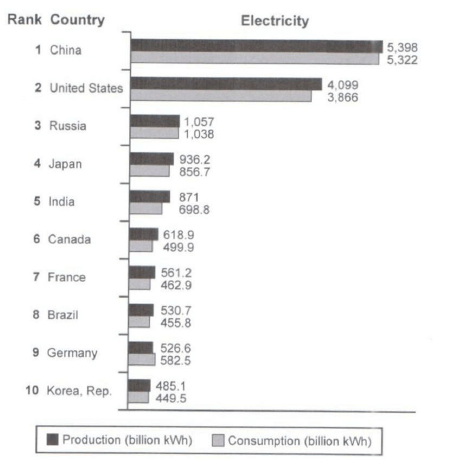
The bar chart below shows the top ten countries for the production and consumption of electricity in 2014.
Summarize the information by selecting and reporting the main features, and make comparisons where relevant.
Student answer (Band 5.5)
The bar graph below compares the data of the top ten countries for the production and utilization of electricity in 2014.
Overall China had the largest figures of both consumption and production of electricity with Germany and Brazil having the least number in the year 2014.
China ranks first in both manufacturing and ultilizing of electricity, showing 5,398 and 5,322. In contrast, US ranking the second position is having a number of 4,099 and 3,866. Furthermore, Russia and Japan having the same number with a similar graph ranking third and fourth in the table with a number 1,057 and 1,038 and 936.2 and 856.7. India and Canada are having a larger number of production with 871 and 618.9 with utilization having 698.8 and 499.9. France ranking seventh position having 561.2 for production and 462.9 for consumption. Whereas, Germany and Brazil having 530.7 and 526.6 for production and 455.8 and 582.5 for consumption. Korea,Rep having 485.1 and 449.5 for manufacturing and Consumption.
AI examiner evaluation
| Criterion | Band |
|---|---|
| Task Achievement / Task Response | 5.0 |
| Coherence and Cohesion | 5.5 |
| Lexical Resource | 5.5 |
| Grammatical Range and Accuracy | 5.0 |
| Overall | 5.5 |
Task Achievement / Task Response: Band 5.0
You identify the chart’s subject and report several key figures, including China’s leading production and consumption and the United States’ second-place values. However, the overview is partly inaccurate: Germany did not have one of the lowest consumption figures, and Brazil was not the lowest in production; Korea had the lowest production and consumption among the listed countries. The body also misassigns the figures for Germany and Brazil: Germany produced 526.6 and consumed 582.5, while Brazil produced 530.7 and consumed 455.8. Several comparisons are unclear or incomplete, and the overview does not highlight the large gap between the top two countries and the rest. A more accurate overview and clearer reporting of the lower-ranked countries would make the response more complete.
Coherence and Cohesion: Band 5.5
The response has a basic overall structure: an opening, a brief overview, and a body that moves through the countries in roughly rank order. This gives the reader a general route through the data. However, progression becomes difficult to follow in the long body paragraph, especially where Russia and Japan’s figures are combined in one sentence and where Germany and Brazil’s values are presented together. Connectors such as “Furthermore,” “In contrast,” and “Whereas” are used, but some do not clearly express the relationship between the information that follows. Separate the data into logical groups, use one sentence per comparison, and make references to production and consumption explicit to improve cohesion and clarity.
Lexical Resource: Band 5.5
You use relevant chart vocabulary, including “production,” “consumption,” “ranks,” and “figures,” so the topic is generally clear. There is also some attempt to vary wording with “manufacturing” and “utilizing.” However, these alternatives are not consistently natural for electricity data, and “number” is repeated where “figure” or “amount” would be more precise. “The least number” is awkward, while “top ten countries” and “bar graph” are appropriate. Spelling and word-form slips, including “ultilizing,” also affect accuracy. Build a more reliable set of chart collocations—such as “generated,” “consumed,” “stood at,” and “recorded”—and use them consistently rather than substituting near-synonyms that do not fit the context.
Grammatical Range and Accuracy: Band 5.0
You attempt both simple and longer sentence forms, and the opening and overview communicate their basic meaning. However, errors recur in sentence construction and verb forms, which sometimes make comparisons hard to interpret. For example, “US ranking the second position is having” lacks a clear finite verb, and “Russia and Japan having the same number” is an incomplete clause. Subject–verb agreement is also inconsistent in “Germany and Brazil having,” and the final sentence uses an unclear capitalisation pattern in “Consumption.” Several sentences join multiple figures without clear grammatical links. Practise complete clauses with a subject and finite verb, such as “Russia produced…, while Japan generated…,” and check agreement and punctuation when combining comparisons.
See this exact question answered at other band scores. The same prompt compared across bands.
Browse more IELTS Writing model answers or get your own writing scored by the same AI examiner.