Band 5.5 IELTS Writing Task 1 Model Answer
Overall Band Score: 5.5 · Cambridge IELTS 13 · 2026-11-13
IELTS Writing Task 1 question
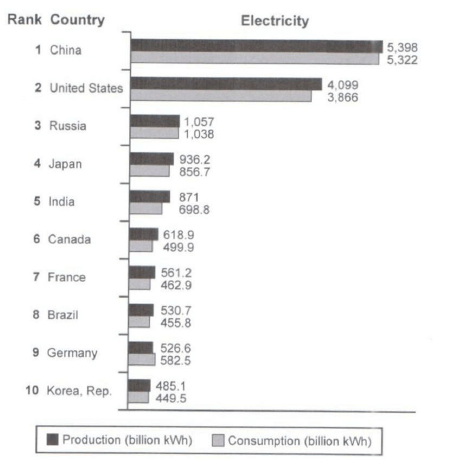
The bar chart below shows the top ten countries for the production and consumption of electricity in 2014.
Summarize the information by selecting and reporting the main features, and make comparisons where relevant.
Student answer (Band 5.5)
The provided bar chart illustrates information regarding the usage and production of electricity by ten countries in the year 2014.
Overall, it is clearly noticeable that in 2014 China generates an 5398 billion kWh electricity and consume electricity around 5322 billion kWh. After that, United States comes in secomd place by genrating electricity exactly 4099 billion kWh and it also consume 3866 billion kWh in 2014.
Furthermore, Russia makes electricity 1057 billion kWh where as Japan build 936.2 billion kWh electricity in 2014, these countries repected usage are 1038 and 856.7 billion kWh. Moving on to the next country that is India, this country generates 871 billion kWh electricity and it used 698.8 billion kWh electricity. Lastly, the remaining 5 countries Canada, France, Brazil, Germany and Korea makes electricity between 450 and 620 billion kWh, these countries used electricity in between 450 and 500 billion kWh in 2014.
In contrast, China and United States produced and consumed most of the electricity in the year 2014.
AI examiner evaluation
| Criterion | Band |
|---|---|
| Task Achievement / Task Response | 5.5 |
| Coherence and Cohesion | 5.5 |
| Lexical Resource | 5.5 |
| Grammatical Range and Accuracy | 5.5 |
| Overall | 5.5 |
Task Achievement / Task Response: Band 5.5
You identify the chart’s subject and year, and correctly report several key figures for China, the United States, Russia, Japan and India. The main overall feature—that China and the United States lead by a large margin—is also stated. However, the overview is not clearly separated from the detailed figures, and the final comparison of the remaining five countries is too broad: Germany’s consumption was 582.5 billion kWh, not within the stated 450–500 range. The response also misses the notable exception that Germany consumed more electricity than it produced, while production exceeded consumption in the other countries. Select the most important comparisons accurately and make these patterns explicit to develop the summary more fully.
Coherence and Cohesion: Band 5.5
The response has a recognisable sequence: an introduction, discussion of the leading countries, a paragraph covering the others, and a concluding comparison. Connectors such as “Furthermore,” “Moving on,” and “Lastly” help signal progression. However, the organisation is largely a country-by-country list rather than a clear grouping of the chart’s main patterns. “Overall” introduces detailed figures, while “In contrast” does not establish a clear contrast with the preceding information. The final sentence also repeats the point about China and the United States being highest. Grouping the figures into leaders, middle-ranking countries and the lower group—and using transitions that express the actual relationship between them—would make the progression clearer and less repetitive.
Lexical Resource: Band 5.5
You use relevant chart vocabulary, including “production,” “consume,” “generates,” and “billion kWh,” so the topic remains understandable. There is also some attempt to vary the wording, for example “makes electricity” and “build” for production. However, several choices are inaccurate or unnatural in this context, and repeated use of “electricity” and “country” limits precision. Spelling errors such as “secomd,” “genrating,” and “repected” are noticeable, while “usage” is less precise than “consumption” for the chart’s measure. Aim for a smaller set of accurate reporting verbs and standard collocations, and check spelling carefully. This would make the description more precise and fluent.
Grammatical Range and Accuracy: Band 5.5
You attempt both simple and longer sentences, including comparisons joined with “whereas,” and the reader can generally follow the intended meaning. However, errors in verb forms and agreement recur: “China generates … and consume” should use matching forms, and “United States comes … and it also consume” has the same agreement problem. Articles and sentence construction are also unreliable in phrases such as “an 5398 billion kWh electricity” and “these countries repected usage are.” The past-time framing is not maintained consistently, with present forms such as “generates” and “makes” used alongside references to 2014. Practise accurate past-tense reporting and parallel sentence structures, then check articles and agreement in each sentence.
See this exact question answered at other band scores. The same prompt compared across bands.
Browse more IELTS Writing model answers or get your own writing scored by the same AI examiner.