Band 6.5 IELTS Writing Task 1 Model Answer
Overall Band Score: 6.5 · Cambridge IELTS 13 · 2026-11-15
IELTS Writing Task 1 question
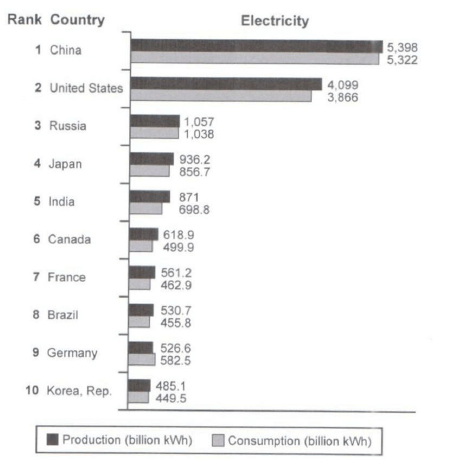
The bar chart below shows the top ten countries for the production and consumption of electricity in 2014.
Summarize the information by selecting and reporting the main features, and make comparisons where relevant.
Student answer (Band 6.5)
The bar chart illustrates the top ten countries, namely China, US, Russia, Japan, India, Canada, France, Brazil, Germany, Republic of Korea electricity production and consumption in 2014.
Overall, all the countries produced more electricity compare to consumption rate, except Germany. Moreover, China produced the most electricity and also consumed the most.
Looking at the chart closely China had produced 5,398 billion kWh electricity and consumed about 5,322 billion kWh. While, Republic of Korea had produced and consumed 485,1 and 449,5 billion kWh electricity. In addition, Russia's electricity production and consumption was relatively similar, 1,057 and 1,038 billion kWh, respectively.
Other country, such as US had ranked second in terms of electricity production and consumption, which was 4,099 and 3,866 billion kWh. Furthermore, Japan, India, Canada, France, and Brazil had showed similar trend of production and consumption of electricity. Also, all these countries had less than 1000 billion kWh electricity production and consumption.
AI examiner evaluation
| Criterion | Band |
|---|---|
| Task Achievement / Task Response | 6.5 |
| Coherence and Cohesion | 6.5 |
| Lexical Resource | 6.0 |
| Grammatical Range and Accuracy | 6.0 |
| Overall | 6.5 |
Task Achievement / Task Response: Band 6.5
You identify the chart’s subject and give a clear overview: China leads both production and consumption, while Germany is the exception to the general pattern of production exceeding consumption. The figures quoted for China, Korea, Russia and the US are accurate, and the response covers the main comparison. However, several important features are only broadly reported. The statement that Japan, India, Canada, France and Brazil showed a similar trend is relevant but gives little sense of their relative scale, and Germany’s unusual consumption figure is not reported or explained. The claim that all these countries were below 1,000 billion kWh is also imprecise because it does not clarify which countries are meant. More selective comparisons would make the summary fuller.
Coherence and Cohesion: Band 6.5
The response has a coherent overall structure: an introduction, an overview, and two paragraphs presenting selected figures and comparisons. The progression from the leading countries to the remaining group is generally easy to follow, and linking expressions such as “Moreover,” “In addition,” and “Furthermore” help signal relationships. This organisation is effective, but cohesion is sometimes mechanical, with several transitions added where a clearer comparison could do more work. For example, “Other country, such as US” shifts abruptly to the US after the Korea and Russia figures, and the final sentence groups five countries without distinguishing their values. Use more precise links to show contrasts and rankings, and make references such as “these countries” unambiguous.
Lexical Resource: Band 6.0
You use an adequate range of task-related vocabulary, including “production,” “consumption,” “respectively,” “ranked second,” and “similar trend.” These choices make the topic clear, and the key terms are repeated appropriately. Some word choices and collocations are less natural or imprecise, however: “consumption rate” is not the best description of the chart’s figures, “had showed similar trend” is awkward, and “Other country” does not fit the plural meaning. The country name “Republic of Korea” is understandable, though “South Korea” would be more concise in this context. Aim for accurate, natural phrases for describing quantities and comparisons, rather than relying on general wording such as “similar trend.”
Grammatical Range and Accuracy: Band 6.0
There is a mix of simple and more complex sentence forms, including the overview’s contrast with “except Germany” and the sentence using “which was” to introduce the US figures. Meaning remains clear throughout, but some grammatical errors occur. For example, “produced more electricity compare to consumption rate” has an incorrect verb form and comparison structure; “China had produced” uses an unnecessary past perfect; and “Other country … had ranked” has problems with number and tense. The sentence beginning “While, Republic of Korea…” is also a fragment, and “all these countries had less than…” has an unclear grammatical reference. Use simple past consistently for the 2014 data and check sentence completeness, agreement, and article use.
See this exact question answered at other band scores. The same prompt compared across bands.
Browse more IELTS Writing model answers or get your own writing scored by the same AI examiner.