Band 5.0 IELTS Writing Task 1 Model Answer
Overall Band Score: 5.0 · Cambridge IELTS 13 · 2026-11-15
IELTS Writing Task 1 question
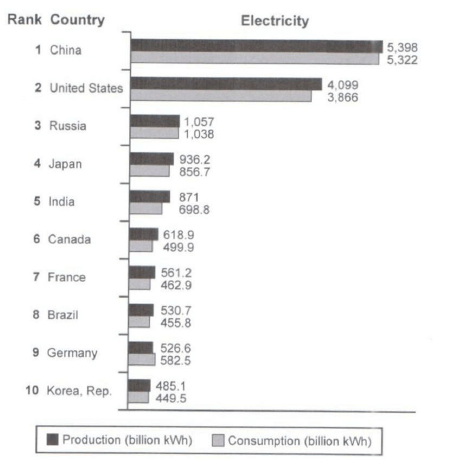
The bar chart below shows the top ten countries for the production and consumption of electricity in 2014.
Summarize the information by selecting and reporting the main features, and make comparisons where relevant.
Student answer (Band 5.0)
the data blow shows the top 10 countries for generation and consumption of electricity in 2014.
overall we can see that all the countries has high production than consumption except germany where. consumption is more than production.
China electricity production in 2014 was 5398 while its consumption was slightly less 5322.
United States production in 2014 is 4099 and consumption is 3866. Russia prodcution in 2014 is 1057 and consumption is slightly less 1038. India electrcity production is 871 while consumption is significantly less 698.8. canada electrcity production is 618.9 while consumption is similarly less 499.9.France electrcity production is 561.2while consumption is significantly less 462.9. Brazil electrcity production is 530.7 while consumption is significantly less 455.8. Germany electrcity production is 485.1 while consumption is slightly more 582.5.korea Rep electrcity production is 485.1 while consumption is significantly less
499.5.
overall the consumption in every contry less than there profuction except germany where the senario is different its complete opposite the consumption is more than production.
AI examiner evaluation
| Criterion | Band |
|---|---|
| Task Achievement / Task Response | 5.5 |
| Coherence and Cohesion | 4.5 |
| Lexical Resource | 5.0 |
| Grammatical Range and Accuracy | 5.0 |
| Overall | 5.0 |
Task Achievement / Task Response: Band 5.5
You identify the main overall pattern: production exceeds consumption in most countries, while Germany is the exception, and you support this with several figures. However, the overview is repeated rather than developed, and the account omits Russia’s and Japan’s figures while giving little comparison of the countries’ relative scale. There are also important data errors: Germany’s production is 526.6, not 485.1, and Korea’s consumption is 449.5, not 499.5. Japan is not discussed. These omissions and inaccuracies make the report only partially complete, although its central comparison is relevant. To strengthen it, give a concise overview of the largest producers and consumers, then select accurate figures that illustrate the main contrasts.
Coherence and Cohesion: Band 4.5
The response has a basic structure, with an opening, an overview, and a sequence of country details, so the reader can identify the topic and the main comparison. However, progression is limited: the overview is repeated almost verbatim at the end, and the body reads largely as a list of separate figures rather than a grouped comparison. Linking is also repetitive, especially the repeated use of “while” and “slightly less.” Some punctuation runs figures and sentences together, as in “499.9.France,” which makes the flow harder to follow. Organise the data into clear groups—for example, the two leading countries and the remaining countries—and use a final overview only once. More varied, accurate transitions would make relationships between figures clearer.
Lexical Resource: Band 5.0
Your vocabulary is sufficient to communicate the topic, using relevant terms such as “production,” “consumption,” “significantly less,” and “slightly more.” However, the range is limited and several expressions are repeated, particularly “electrcity production” and “consumption is … less.” Spelling errors such as “prodcution,” “contry,” and “profuction” are noticeable, and phrases like “the data blow shows” and “the senario is different” are inaccurate or informal for an academic report. Use precise reporting language and check spelling carefully. For example, “generated” or “produced” can vary the repeated use of “production,” while “exceeded” and “was lower than” express comparisons more naturally and concisely.
Grammatical Range and Accuracy: Band 5.0
You communicate the basic comparisons using simple clauses and some contrast structures, such as “while its consumption was slightly less.” However, the sentence patterns are quite repetitive, and errors occur frequently enough to make parts of the report awkward. Examples include “all the countries has,” where the subject and verb do not agree, and “the consumption in every contry less than there profuction,” which lacks a verb and has unclear pronoun reference. Tense also shifts between “was” and “is” when describing the same 2014 data. Punctuation is inconsistent, with missing spaces and sentence boundaries. Practise accurate present-tense reporting or consistent past tense, subject–verb agreement, and complete comparison clauses before attempting more varied structures.
See this exact question answered at other band scores. The same prompt compared across bands.
Browse more IELTS Writing model answers or get your own writing scored by the same AI examiner.