Band 5.5 IELTS Writing Task 1 Model Answer
Overall Band Score: 5.5 · Cambridge IELTS 13 · 2026-11-15
IELTS Writing Task 1 question
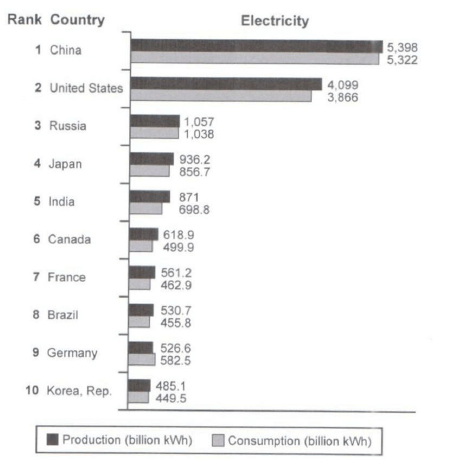
The bar chart below shows the top ten countries for the production and consumption of electricity in 2014.
Summarize the information by selecting and reporting the main features, and make comparisons where relevant.
Student answer (Band 5.5)
The chart shows the data of consumption and the production of electricity in 2014, where we see the usage of top ten countries in the world.
In China and the United States, use the significant amount of electricity. The China make 5,398 (billion kwh) electricity and use 5,322 (billion kwh). Instead of that United States make slightly less amount of energy as we compared to China which is 4,099 (Billion kwh). The utilization of United States is 3,866 (Billion kwh) which is lesser than China. But United States save much electricity than China.
On the other hand, the consumption of electricity in Russia is very near to there production. Furthermore, Japan, India, Canada, France, and Brazil they save electricity around 10% in 2014 as compared to their production.
The countries that facing problems, these are Germany and Korea, Rep. because there consumption of electricity is higher than their production.
Overall, United States and China makes too much amount of electricity as compared to other countries. Few countries save the electricity and the last two countries face challenges for their usage as they produce less electricity.
AI examiner evaluation
| Criterion | Band |
|---|---|
| Task Achievement / Task Response | 6.0 |
| Coherence and Cohesion | 6.5 |
| Lexical Resource | 5.0 |
| Grammatical Range and Accuracy | 5.0 |
| Overall | 5.5 |
Task Achievement / Task Response: Band 6.0
You identify the main contrast clearly: China and the United States produce and consume far more electricity than the other countries, and you include several accurate figures for these two leaders. You also note that Russia’s production and consumption are close, and that Germany consumes more than it produces. However, some comparisons are incomplete or inaccurate: Germany is the only country in the list whose consumption exceeds production, whereas Korea’s consumption (449.5) is below its production (485.1). The claim that Japan, India, Canada, France and Brazil each save around 10% is too broad, since the differences vary, and the overview’s reference to “the last two countries” repeats the Korea error. Develop the overview with precise, chart-based comparisons.
Coherence and Cohesion: Band 6.5
The response has a clear overall arrangement: an introduction, paragraphs comparing the leading countries and the remaining figures, and a concluding overview. This makes the main progression easy to follow. You also use linking expressions such as “On the other hand” and “Furthermore” to connect points. However, some links do not accurately express the relationship between the data: “On the other hand” introduces Russia without a clear contrast, and “But” in the United States comparison is followed by a claim about saving electricity that is not well supported. References such as “there production” and “the last two countries” are also unclear or misleading. To strengthen cohesion, group comparisons more deliberately and use linking phrases only when their logical function is clear.
Lexical Resource: Band 5.0
You use relevant topic vocabulary, including “production,” “consumption,” “electricity,” and “significant amount,” so the reader can generally understand the subject. However, the range and precision are limited, with repeated use of “make,” “use,” “amount,” and “save” to describe different data relationships. Several expressions are unnatural or imprecise, such as “use the significant amount of electricity,” “make … electricity,” and “face challenges for their usage.” “Save electricity” also suggests conservation, rather than simply consuming less than a country produces. Aim for accurate reporting verbs and collocations, such as “generated,” “consumed,” “exceeded,” and “was slightly below.” This would make comparisons clearer and more appropriate to an academic chart summary.
Grammatical Range and Accuracy: Band 5.0
You attempt both simple and more complex sentences, including comparisons with “as compared to” and a subordinate clause beginning “because.” Meaning is usually recoverable, but errors in agreement, articles, and sentence construction occur across the response. For example, “The China make” and “United States and China makes” have incorrect subject–verb agreement, while “In China and the United States, use…” lacks a clear grammatical subject. The sentence “Japan, India, Canada, France, and Brazil they save…” combines a subject and pronoun awkwardly, and “there production” uses the wrong possessive form. Work on complete sentence patterns, consistent plural agreement, and possessives; then check articles and punctuation. More accurate control of these forms would make your comparisons easier to read.
See this exact question answered at other band scores. The same prompt compared across bands.
Browse more IELTS Writing model answers or get your own writing scored by the same AI examiner.