Band 6.5 IELTS Writing Task 1 Model Answer
Overall Band Score: 6.5 · Cambridge IELTS 13 · 2026-11-15
IELTS Writing Task 1 question
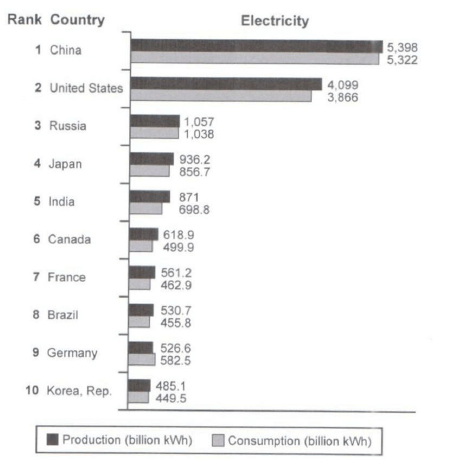
The bar chart below shows the top ten countries for the production and consumption of electricity in 2014.
Summarize the information by selecting and reporting the main features, and make comparisons where relevant.
Student answer (Band 6.5)
The bar chart illustrates the top ten contries which produced and consumed electricity the most during 2014.
Overall, China and United states generated and consumed the highest amount of electricity while Korea was on the bottom of the list. All nations used less then what they produced except for Germany which had a higher usage of electricity compared to what it generated.
China ranked the first producing 5398 billion kWh and consuming only 5322 of it. Similarly the US had an excess of 233 kWh of electricity. Russia was third on the list with a capacity of 1057 kWh and usage of 1038 kWh.
This trend was followed by countries moving down the list of the countries including Japan, then India, Canada, france, Brazil and Korea. Germany was the only country which had a higher demand than its supply. It could generated 526 kWh but need more than this capacity having a demand of 582.5 kWh.
AI examiner evaluation
| Criterion | Band |
|---|---|
| Task Achievement / Task Response | 6.5 |
| Coherence and Cohesion | 6.5 |
| Lexical Resource | 6.0 |
| Grammatical Range and Accuracy | 6.0 |
| Overall | 6.5 |
Task Achievement / Task Response: Band 6.5
You identify the main pattern accurately: China and the United States lead both measures, Korea is among the lowest, and Germany is the exception to the general pattern of production exceeding consumption. The figures for China and Russia are also reported correctly. This gives the response a clear overview and relevant supporting detail. However, some comparisons are only partly developed: the United States’ production figure is omitted, and the middle-ranked countries are grouped together without reporting useful figures or contrasts. The statement that Korea was “on the bottom” is also imprecise, since Germany’s consumption is higher than Korea’s. To strengthen the response, include a few more key figures and make the ranking distinction precise.
Coherence and Cohesion: Band 6.5
The response has a clear overall arrangement, moving from an introduction and overview to details about the leading countries and then the remaining group. Paragraphing helps the reader distinguish the main features, and linking expressions such as “Overall,” “Similarly,” and “This trend” provide some progression. However, the final paragraph becomes a broad list of countries rather than a well-organised comparison, and “This trend” is not fully clear because the countries’ figures and relative differences are not explained. The transition from the United States to Russia also leaves the US comparison incomplete. Grouping countries by meaningful similarities and using clearer references would make the progression more flexible and precise.
Lexical Resource: Band 6.0
You use an adequate range of task-related vocabulary, including “generated,” “consumed,” “capacity,” “demand,” and “supply,” so the main comparisons are understandable. There are also some attempts to vary expression, such as “ranked the first” and “had an excess.” However, several choices are inaccurate or awkward: “ranked the first” is not idiomatic, “on the bottom” is imprecise, and “an excess of 233 kWh” does not clearly describe the US production-consumption difference. Spelling errors such as “contries,” “then,” and “france” also reduce accuracy. Use standard chart language consistently, such as “ranked first,” “lowest,” and “produced more electricity than it consumed,” and check spelling before submitting.
Grammatical Range and Accuracy: Band 6.0
You use a mix of simple and more complex forms, including the overview sentence with “while” and the contrast introduced by “except for Germany.” Most of the meaning remains clear, and several sentences are structurally sound. Some grammatical errors nevertheless persist. For example, “All nations used less then what they produced” needs a comparative construction such as “consumed less than they produced,” while “It could generated” should be “It could generate” or “It generated.” In “having a demand of 582.5 kWh,” the participle construction is awkward, and the sentence would be clearer as “although consumption reached 582.5 billion kWh.” Continue practising verb patterns and comparative structures, while aiming for more consistently accurate complex sentences.
See this exact question answered at other band scores. The same prompt compared across bands.
Browse more IELTS Writing model answers or get your own writing scored by the same AI examiner.