Band 5.5 IELTS Writing Task 1 Model Answer
Overall Band Score: 5.5 · Cambridge IELTS 13 · 2026-11-16
IELTS Writing Task 1 question
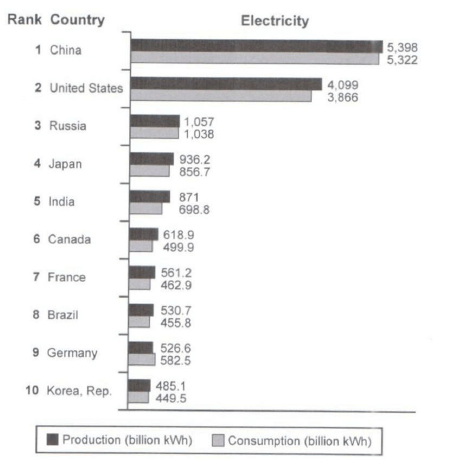
The bar chart below shows the top ten countries for the production and consumption of electricity in 2014.
Summarize the information by selecting and reporting the main features, and make comparisons where relevant.
Student answer (Band 5.5)
This graph here provides the information about the top ten countries' figures regarding the production and comsumption of electricity.
This graph tells us the details of production and consumption of elecricity in billion kWh. The country which is at the top is China with the production of 5,398 billion kWh of electricity and the last one in the graph is Republic of Korea with the production of 485.1 billion kWh of electricity. This graph also shows us the balance between production and consumption in a country. We can see that Germany is the only country which has more consumption than production. It means they do buy electricity from some other country. There are some contries like Russia, China and Republic of Korea, they do not save any huge amount electricity. The amount they produce they consume that as well. If we talk about the countries who are saving some amount of electricity, these are United States, India, Canada and France.
AI examiner evaluation
| Criterion | Band |
|---|---|
| Task Achievement / Task Response | 5.5 |
| Coherence and Cohesion | 5.5 |
| Lexical Resource | 5.5 |
| Grammatical Range and Accuracy | 5.5 |
| Overall | 5.5 |
Task Achievement / Task Response: Band 5.5
You identify relevant features, including China’s highest production, Korea’s lowest production, and Germany as the only country where consumption exceeds production. However, the response only partially summarises the chart: it gives little comparison across the figures and does not mention the very large gap between China and the United States and the remaining countries. The claim that China, Russia and Korea “do not save any huge amount” is unclear and not directly supported by the chart; their production is only slightly above consumption, but the chart does not show saving. Also, the United States, India, Canada and France are named as producing a surplus, while Japan and Brazil are omitted. A clearer overview and more accurate, selective comparisons would make the report more complete.
Coherence and Cohesion: Band 5.5
The response has a basic sequence: it introduces the chart, reports the highest and lowest production figures, and then discusses differences between production and consumption. Linking phrases such as “If we talk about” help signal a shift in focus. However, the ideas do not develop into a clear overall progression, and the two opening sentences repeat the same introductory point. The final section groups countries without explaining the basis of the grouping consistently, and “It means” has an unclear reference. Organise the report into a concise introduction, an overview of the main patterns, and a paragraph with selected comparisons. Use references such as “this small surplus” or “these countries” only when their meaning is unmistakable.
Lexical Resource: Band 5.5
You use some task-relevant vocabulary, including “production,” “consumption,” and “billion kWh,” and the main meaning is generally understandable. However, the range is limited and several expressions are imprecise or informal for an academic chart summary. “This graph here provides the information” and “The country which is at the top” are wordy, while “saving some amount of electricity” does not accurately describe a production surplus. There are also noticeable spelling errors, including “comsumption,” “elecricity,” and “contries.” Choose concise reporting language and use terms such as “generated,” “used,” and “produced more than it consumed.” Proofreading spelling and collocations would make the comparisons clearer and more appropriate.
Grammatical Range and Accuracy: Band 5.5
You produce several understandable simple sentences and attempt longer structures, for example, “The country which is at the top is China…” and “We can see that Germany is the only country…”. However, the range is limited, and some sentence patterns are awkward or incomplete. In “There are some contries like Russia, China and Republic of Korea, they do not save…,” the comma joins two clauses that should be connected with “which” or separated into sentences. “The amount they produce they consume that as well” also has an unclear structure; a clearer form is “They consume almost as much electricity as they produce.” Check articles and sentence boundaries, for example, “the Republic of Korea.” More controlled complex sentences would help express comparisons accurately.
See this exact question answered at other band scores. The same prompt compared across bands.
Browse more IELTS Writing model answers or get your own writing scored by the same AI examiner.