Band 6.0 IELTS Writing Task 1 Model Answer
Overall Band Score: 6.0 · Cambridge IELTS 13 · 2026-11-16
IELTS Writing Task 1 question
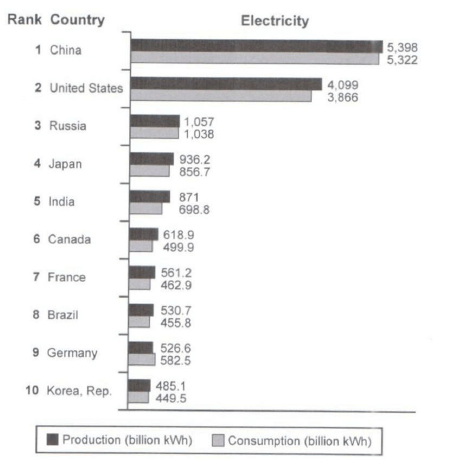
The bar chart below shows the top ten countries for the production and consumption of electricity in 2014.
Summarize the information by selecting and reporting the main features, and make comparisons where relevant.
Student answer (Band 6.0)
The given bar chart illustrates the production and consumption of electricity by top ten countries in 2014. Production of electricity is illustrated by black bar while consumption by blue. The unit used to measure electricity production is billion kWh. China was the top one in production and consumption. All countries made enough electricity to meet their needs except Germany. Major production and consumption gap occured in The United States.
China-the largest country in terms of production and consumption- produced 5,398 billions kWh of electricity and consumed 5,322 billions kWh in 2014. Korea Republic the 10th largest country in electricity production, poduced 485.1 billions kWh electricity and consumed 449.5 billions kWh. Germany was the 9th largest country in terms of electricity production producing 526.6 billions kWh but it is astonishing that Germany could not meet the demands of consumption of electricity as consumption was more than the production.
The largest gap between the production and consumption was observed in the 2nd largest producer, that was United States, it produced 4,099 billions kWh electricty while consumed 3,866 billions kWh. Russia was the third largest country which produced 1,057 billions kWh and consumed 1,038 billions kWh. Japan was the 4th largest country with the production of 936.2 billions kWh electrcity and consumption of 856.7 billion kWh.
Overall, China was the largest consumer and producer while Korea was the smallest. All countries produced enough electrcity to fulfil their needs except Germany.
AI examiner evaluation
| Criterion | Band |
|---|---|
| Task Achievement / Task Response | 6.0 |
| Coherence and Cohesion | 6.0 |
| Lexical Resource | 6.0 |
| Grammatical Range and Accuracy | 6.0 |
| Overall | 6.0 |
Task Achievement / Task Response: Band 6.0
You identify the chart’s subject and give a clear overview: China leads both measures, Korea is the smallest producer, and Germany is the exception where consumption exceeds production. Several figures are reported accurately, including China, the United States, Russia, Japan and Korea. However, the overview is not fully precise: the United States has the largest absolute production–consumption difference, but the gap is modest relative to its totals, and Germany’s consumption figure (582.5) is not stated. The claim that all other countries produced enough for their needs is supported by the data, but the response focuses heavily on selected countries and gives little comparison of the middle-ranked nations. Include Germany’s figures and compare the overall pattern more fully to develop the key features.
Coherence and Cohesion: Band 6.0
The response has a generally coherent structure, moving from an introduction and overview to country-specific details, and the information is mostly easy to follow. Paragraphing helps separate the overview from the figures. However, the organisation is not fully effective: the overview is split between the opening and the final paragraph, where the same points about China, Korea and Germany are repeated. The sequence of examples also follows rankings without consistently grouping or comparing related data. Some linking is mechanical, particularly repeated constructions such as “which produced” and “while consumed.” Bring the overview together in one place, then organise the details into clear comparisons—for example, the two leading countries and the lower-producing group—and use referencing and transitions more variedly.
Lexical Resource: Band 6.0
You use an adequate range of task-related vocabulary, including “production,” “consumption,” “largest,” “gap” and “meet their needs,” so the main comparisons are understandable. There are also attempts at more formal phrasing, such as “in terms of” and “the largest gap … was observed.” However, some word choices and collocations are awkward or imprecise: “top one” is less natural than “leading country,” and “the demands of consumption of electricity” is unnecessarily cumbersome. Spelling errors such as “poduced,” “electricty” and “electrcity” also reduce accuracy. Use concise, conventional chart language and check spelling carefully; for example, describe Germany as having consumption “exceed production” rather than saying it “could not meet the demands.”
Grammatical Range and Accuracy: Band 6.0
You use a mix of simple and more complex sentence forms, including the relative clause in “Korea Republic the 10th largest country …” and the contrast introduced by “while.” Most sentences communicate the intended meaning, but some grammatical errors remain. For example, “China-the largest country …- produced” needs clearer punctuation around the inserted phrase, and “Korea Republic the 10th largest country” lacks a verb or suitable punctuation. There are also inconsistent forms in “Germany … producing … but it is astonishing that …,” where the sentence shifts awkwardly between a participial phrase and a finite clause. Improve sentence boundaries and use complete, consistently structured clauses; also check plural forms such as “billions kWh,” which should be expressed as “billion kWh.”
See this exact question answered at other band scores. The same prompt compared across bands.
Browse more IELTS Writing model answers or get your own writing scored by the same AI examiner.