Band 5.0 IELTS Writing Task 1 Model Answer
Overall Band Score: 5.0 · Cambridge IELTS 13 · 2026-11-17
IELTS Writing Task 1 question
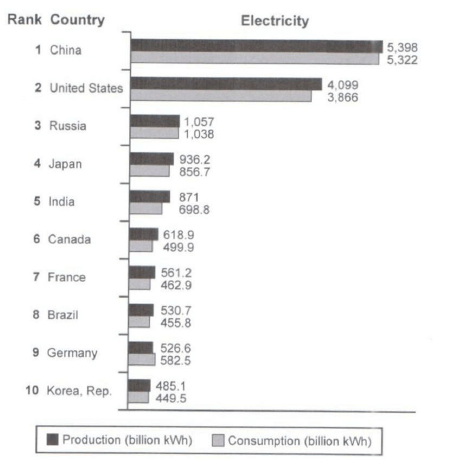
The bar chart below shows the top ten countries for the production and consumption of electricity in 2014.
Summarize the information by selecting and reporting the main features, and make comparisons where relevant.
Student answer (Band 5.0)
The graph illustrates the top countries for the production and consumption of electricity in 2014. According to the graph, China has the greatest production of electricity of 5, 398 billion kWh and consumption of 5, 322 billion kWh. This is followed by the United States where the country has a total production of electricity of 4, 099 billion kWh and consumption of 3, 866 billion kWh. Furthermore, Russia only has a remaining of 19 billion kWh of electricity remaining as they use 1, 038 billion kWh of electricity. Germany uses 55.9 billion kWh more than it had produced in 2014, which presents their overconsumption of electricity. Other countries, apart from Germany does not comsump more electricity than they can produced. Lastly, Korean, Rep produces 485.1 billion kWh of electricity and only has a remaining of 35.6 billion kWh in 2014.
AI examiner evaluation
| Criterion | Band |
|---|---|
| Task Achievement / Task Response | 4.5 |
| Coherence and Cohesion | 5.0 |
| Lexical Resource | 5.5 |
| Grammatical Range and Accuracy | 5.5 |
| Overall | 5.0 |
Task Achievement / Task Response: Band 4.5
You identify the two leading countries and report several relevant figures, including China’s production and consumption and Germany’s higher consumption than production. However, the response does not provide a clear overall summary of the main pattern across the chart, and several comparisons are missing or unclear. The statement that Russia has “19 billion kWh ... remaining” is an interpretation rather than a useful comparison of the two measures; similarly, the final figure for Korea is not explained against its consumption. The claim that all countries except Germany consume less than they produce is inaccurate: Germany is the only country where consumption exceeds production, but the response’s wording “does not comsump” obscures this point. The response is 130 words, below the required 150, which limits its coverage.
Coherence and Cohesion: Band 5.0
The response follows a generally understandable sequence, moving from China and the United States to other countries, and uses basic linking phrases such as “This is followed by,” “Furthermore,” and “Lastly.” However, it is presented as one paragraph and lacks a clear overview that would guide the reader through the main comparisons. The progression between details is also uneven: Russia’s “remaining” amount is followed by Germany’s overconsumption, then a broad statement about the other countries, without consistently explaining the figures behind each point. Some references, such as “they” for Russia and “their” for Germany, are not well controlled. Grouping the overview separately and organising the details into clear comparisons would make the report easier to follow.
Lexical Resource: Band 5.5
You use relevant task vocabulary, including “production,” “consumption,” “greatest,” and “overconsumption,” and the electricity units are generally communicated clearly. However, some wording is repetitive or imprecise: “remaining” is used twice for the difference between production and consumption, and “has a total production of electricity” is unnecessarily wordy. There are also noticeable word-form and spelling problems, including “comsump” and “Korean, Rep,” which reduce accuracy. Phrases such as “a remaining of 19 billion kWh” are not natural collocations. Aim for precise comparison language such as “produced 19 billion kWh more than it consumed” and use the country name “South Korea” or “the Republic of Korea” consistently.
Grammatical Range and Accuracy: Band 5.5
The response includes some correctly formed simple sentences, such as “The graph illustrates the top countries for the production and consumption of electricity in 2014,” and attempts longer structures with “where” and “which.” However, agreement and verb-form errors occur in several places. In “Other countries ... does not,” the plural subject requires “do not”; “than they can produced” should use “produce”; and “Germany uses ... more than it had produced” shifts awkwardly between present and past forms. The sentence about Russia also has an unclear construction, while commas in figures (“5, 398”) are incorrectly spaced. These errors do not prevent the general meaning from being understood, but more consistent agreement, tense control, and sentence construction are needed.
See this exact question answered at other band scores. The same prompt compared across bands.
Browse more IELTS Writing model answers or get your own writing scored by the same AI examiner.