Band 4.5 IELTS Writing Task 1 Model Answer
Overall Band Score: 4.5 · Cambridge IELTS 13 · 2026-11-19
IELTS Writing Task 1 question
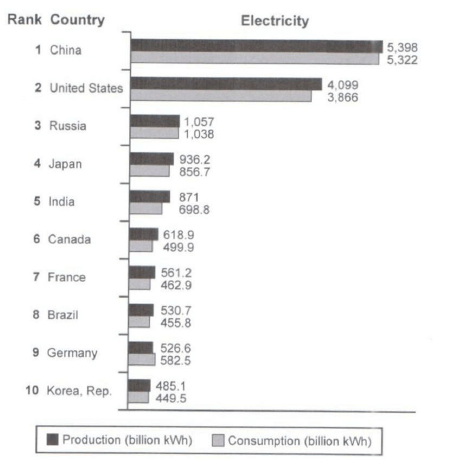
The bar chart below shows the top ten countries for the production and consumption of electricity in 2014.
Summarize the information by selecting and reporting the main features, and make comparisons where relevant.
Student answer (Band 4.5)
Electricity is the most significant need globally .All over the world it produced and comsumed by every nation.Here we sum up the data by gathering and presenting main factors and create likewise information between the country .
Korea produce least amount of electricity or also consumed very less electricity , after that it gradually increased in number of production and consumption of electricity from down to upward Germany comes in list then brazil which use and produce more then both germany and korea . canada manufacture and spend more then france then india came in rank of spending and creating electricity . Then japan ,russia , US, china came enlist which produced more and more light and used it .
The given data presented that china produces very high amount of electricity and used it more then other nine countries that is 5398 production and 5322 consumption or comparitively with the 10th country that manufacture least amount and used least amount .
AI examiner evaluation
| Criterion | Band |
|---|---|
| Task Achievement / Task Response | 4.5 |
| Coherence and Cohesion | 4.5 |
| Lexical Resource | 4.5 |
| Grammatical Range and Accuracy | 4.5 |
| Overall | 4.5 |
Task Achievement / Task Response: Band 4.5
You identify the broad pattern that China is the largest producer and consumer, and you note that Korea is at the bottom of the production ranking. However, the response only minimally reports the chart’s key features. The sequence from Korea through China is described vaguely, without a clear overview of the main contrasts or accurate supporting comparisons. The claim that Germany is among the countries with the least consumption is not supported: its consumption, at 582.5 billion kWh, is higher than its production and exceeds that of several countries listed above it. The figures for China are accurate, but most other values are omitted. To strengthen the report, give a concise overview and select a few precise comparisons, including Germany’s exception.
Coherence and Cohesion: Band 4.5
There is an attempt to organise the response from the lower-ranked countries towards the highest-ranked ones, and the final paragraph returns to China as the main feature. However, the progression is difficult to follow because several countries and comparisons are crowded into one long paragraph, while the opening comments do not help organise the chart description. Linking phrases such as “after that” and “then” are repeated and sometimes leave the relationship between countries unclear. The second paragraph also mixes production and consumption without consistently distinguishing them. Use separate paragraphs for an overview and grouped comparisons, and connect each comparison explicitly to production or consumption. This would make the information easier to follow.
Lexical Resource: Band 4.5
The response uses some relevant chart vocabulary, including “production,” “consumption,” “amount,” and “rank,” so the reader can recognise the general topic. However, the range is basic and repetitive, and several word choices or collocations strain understanding. For example, “used and produce more then both germany and korea” is an imprecise way to compare the figures, while “produced more and more light” is not an appropriate description of electricity output. There are also spelling errors such as “comsumed,” “comparitively,” and “enlist.” Aim for accurate, neutral report language and use verbs such as “generated” and “consumed,” alongside comparison phrases such as “slightly higher than” or “substantially exceeded.”
Grammatical Range and Accuracy: Band 4.5
The response attempts both simple statements and longer sentences, but grammatical errors are frequent and sometimes make relationships between ideas unclear. Examples include “it produced and comsumed by every nation,” which lacks an auxiliary and has an unclear subject, and “Korea produce least amount,” where the verb form and article are missing. The long sequence beginning “Then japan, russia, US, china came enlist” also has problems with sentence construction and punctuation. Capitalisation and spacing around full stops are inconsistent. Practise accurate subject–verb agreement, articles, and complete sentence patterns before adding longer clauses. Shorter, clearly punctuated comparisons would help communicate the data more reliably.
See this exact question answered at other band scores. The same prompt compared across bands.
Browse more IELTS Writing model answers or get your own writing scored by the same AI examiner.