Band 6.0 IELTS Writing Task 1 Model Answer
Overall Band Score: 6.0 · Cambridge IELTS 13 · 2026-11-19
IELTS Writing Task 1 question
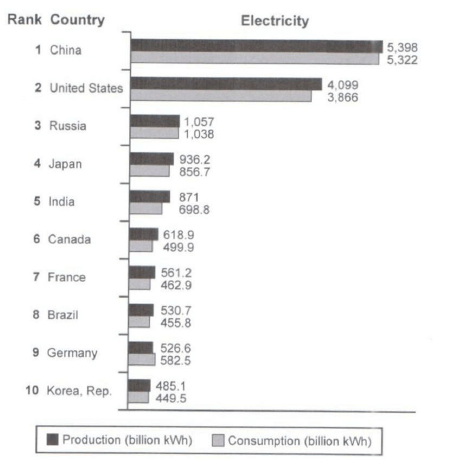
The bar chart below shows the top ten countries for the production and consumption of electricity in 2014.
Summarize the information by selecting and reporting the main features, and make comparisons where relevant.
Student answer (Band 6.0)
The bar chart illustrates the China, US, Russia, Japan, India, Canada, France, Brazil, Germany and Republic of Korea for the output and usage of electricity in 2014.
Overall, the China and United States produced and consumsed large amount of electricity because these are the largest economies in contrast to others. However, in Germany the consumption of electic current was high as compared to production due to its moderate economy.
Firstly, it can be seen that the China and America generated 5,398billion and 4,099billion(kWh) of energy, Although the usage of these countries was lessen than their production, that is 5,322billion and 3,866billion(kWh). In Russia and Korea, the usage and production was almost same, however it ranks about on number 3 and 10. Moreover, Japan and India had generated 936.2billion and 871billion(kWh) of electicity, while it could be used 856.7billion and 698.8billion(kWh), nevertheless India had a big population and Japan had a advanced country.
In addition, Canada and France generated 618.9billion and 561.2billion(kWh), but both nations consumed 499.9billion and 462.9billion(kWh). Similarly, Brazil generated 530.7billion and used 455.8billion(kWh). Whereas, the big change seen in the production and consumption of electricity in Germany because there usage was high as compared to production in 2014 that was 582.5billion and 526.6billion(kWh).
AI examiner evaluation
| Criterion | Band |
|---|---|
| Task Achievement / Task Response | 6.0 |
| Coherence and Cohesion | 6.0 |
| Lexical Resource | 5.5 |
| Grammatical Range and Accuracy | 5.5 |
| Overall | 6.0 |
Task Achievement / Task Response: Band 6.0
You identify the main pattern accurately: China and the United States lead both production and consumption by a wide margin, and Germany is the exception where consumption exceeds production. Most figures you report, including those for China, the US, Japan, India, Canada, France and Brazil, match the chart. However, the overview adds unsupported explanations about countries’ economies, population and development; these are not shown by the data and distract from the comparison. The statement that Russia and Korea have almost equal production and consumption is broadly accurate, but the overview could more clearly summarise the overall pattern across the remaining countries. To strengthen the response, focus on the largest contrasts and the Germany exception, and avoid causal claims not supported by the chart.
Coherence and Cohesion: Band 6.0
The response has a clear overall arrangement: an introduction, an overview, and two paragraphs comparing groups of countries. This makes the information generally easy to follow, and sequencing phrases such as “Firstly” and “In addition” help signal progression. However, some links are mechanical or awkward, and a few references are unclear. For example, “while it could be used” does not clearly refer to the electricity figures, and “there usage” makes the Germany comparison harder to follow. The sentence beginning “Whereas” is also left as a fragment. Grouping countries more consistently and using direct comparisons would improve the flow; for example, present production and consumption figures together for each group, then finish with Germany’s contrasting pattern.
Lexical Resource: Band 5.5
You use a reasonable range of task-related vocabulary, including “illustrates,” “generated,” “consumed,” and “in contrast,” so the main comparisons are usually understandable. However, several word-choice, spelling and collocation problems reduce precision: “consumsed,” “electic,” and “electicity” are misspelled, while “the usage … was lessen” and “big change seen” are unnatural. “Output” and “usage” are understandable alternatives, but “electricity production” and “electricity consumption” would be more precise and consistent. Avoid expressions such as “moderate economy” and “advanced country” when the chart provides no evidence for these descriptions. More accurate collocations and careful proofreading would make your vocabulary more effective for this data-reporting task.
Grammatical Range and Accuracy: Band 5.5
You attempt both simple and complex sentences, using clauses with “although,” “while” and “because,” and the main message remains understandable. Some grammatical errors occur, particularly with articles, agreement and sentence boundaries. For example, “the China and United States” needs more accurate article use, and “the usage and production was almost same” has agreement and article problems. The sentence beginning “Whereas” is incomplete, while “Although the usage … was lessen” combines a subordinate clause with an incorrect verb form. There are also punctuation issues, such as the comma splice after “energy.” Aim to form complete sentences, check subject–verb agreement, and use past-tense forms consistently when describing the 2014 figures.
See this exact question answered at other band scores. The same prompt compared across bands.
Browse more IELTS Writing model answers or get your own writing scored by the same AI examiner.