Band 6.0 IELTS Writing Task 1 Model Answer
Overall Band Score: 6.0 · Cambridge IELTS 13 · 2026-11-19
IELTS Writing Task 1 question
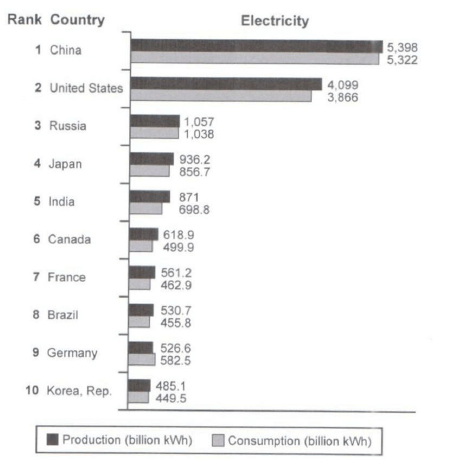
The bar chart below shows the top ten countries for the production and consumption of electricity in 2014.
Summarize the information by selecting and reporting the main features, and make comparisons where relevant.
Student answer (Band 6.0)
The bar chart compares the production and consumption of electricity in Kwh of the top ten countries in the year 2014.
Overall, it is clear that China and United State recorded the highest countries for both production and consumption of electricity throughout the period, however, Corea, Rep and Germany were the lowest.
On the one hand, China produced and consumed more than other countries with 5,398 billion KWh for the production and consumed 5,322 billion KWh. United State was the second highest country in production électricity of about 4,099 billion KWh when it consumed 3,866.
On the other hand, Russia consumed the same amount of electricity that produced with about 1,057 billion KWh. The other top ten countries for the production and consumption of electricity in 2014 which were Japan, India, Canada, France, Brazil and Corea, Rep produced more than consumed and were the lowest countries over the period, exept Germany which consumed 582.5 billion KWh more than produced of about 526.5 billion KWh.
AI examiner evaluation
| Criterion | Band |
|---|---|
| Task Achievement / Task Response | 6.0 |
| Coherence and Cohesion | 6.0 |
| Lexical Resource | 5.5 |
| Grammatical Range and Accuracy | 5.5 |
| Overall | 6.0 |
Task Achievement / Task Response: Band 6.0
You identify the chart’s subject and give a clear overview by noting that China and the United States lead both measures, while Germany and South Korea are among the lowest-ranked countries. You also include several relevant figures, especially for China and the United States, and correctly highlight Germany as an exception because its consumption exceeds production. However, some comparisons are inaccurate or unclear: Russia’s production and consumption are close, but not the same, and the sentence grouping Japan through South Korea does not report their figures or distinguish their relative levels. Germany’s production is also given as about 526.5 rather than 526.6. More precise comparisons and a fuller account of the middle-ranking countries would make the key features clearer and better supported.
Coherence and Cohesion: Band 6.0
The response has a recognisable structure: an introduction, an overview, and two body paragraphs. The contrastive signposts “On the one hand” and “On the other hand” help separate the leading countries from the remaining data, and the main progression is generally understandable. However, the second body paragraph combines several countries in one long sentence, making the comparisons difficult to follow; the phrase “which were Japan, India, Canada, France, Brazil and Corea, Rep produced…” also has an unclear grammatical connection. The overview’s claim that Germany and Korea were the lowest is not clearly reconciled with the later list. Group countries more deliberately and use clearer references and sentence boundaries to improve cohesion.
Lexical Resource: Band 5.5
You use relevant task vocabulary, including “production,” “consumption,” “highest,” and “produced more than consumed,” so the topic is communicated. There is some repetition of “electricity” and “country,” and several word choices or collocations are inaccurate or awkward: “recorded the highest countries” and “the lowest countries” do not naturally describe the data. Spelling and form errors such as “United State,” “Corea,” “exept,” and “électricity” also reduce accuracy. Aim for precise comparison language and check country names and spelling. A wider set of accurate terms such as “ranked first,” “output,” and “exceeded” would make the report more fluent and appropriately formal.
Grammatical Range and Accuracy: Band 5.5
You attempt both simple and complex sentence forms, including a contrast clause with “however” and a relative clause beginning “which were.” The main message remains understandable, but some grammatical errors affect clarity. For example, “China and United State recorded the highest countries” has an incorrect sentence pattern, while “Russia consumed the same amount of electricity that produced” omits the subject in the second clause. In “when it consumed 3,866,” the comparison would be clearer with a complete parallel structure. The long final sentence also contains several clauses that are not joined cleanly. Practise accurate comparative sentence patterns and check subject–verb structure, articles, and punctuation when combining ideas.
See this exact question answered at other band scores. The same prompt compared across bands.
Browse more IELTS Writing model answers or get your own writing scored by the same AI examiner.