Band 6.5 IELTS Writing Task 1 Model Answer
Overall Band Score: 6.5 · Cambridge IELTS 13 · 2026-11-21
IELTS Writing Task 1 question
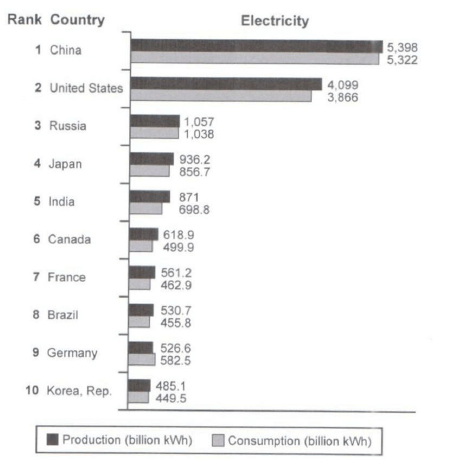
The bar chart below shows the top ten countries for the production and consumption of electricity in 2014.
Summarize the information by selecting and reporting the main features, and make comparisons where relevant.
Student answer (Band 6.5)
The bar chart illustrates the production and consumption of electricity in billion kilowatt-hours among the top ten electricity-generating countries in 2014.
China remained at the top in both production and consumption of electricity in 2014. The United States, Russia, Japan, India, Canada, France, Brazil, Germany, and the Republic of Korea followed, respectively.
It is worth-mentioning that the production and consumption of electricity in the top four countries is nearly equal. However, rest of the countries produce more electricity than their consumption. Another notable feature is that India has a population way greater than that of Japan, yet Japan produces more electricity. The same argument holds good for Brazil and France.
In a nutshell, it may be argued that electricity consumption is not related to a country's population. Rather, electricity production and consumption show a comparable pattern with the technological advancements in the countries. More advanced countries or developed countries' electricity generation and consumption outnumbers developing countries.
AI examiner evaluation
| Criterion | Band |
|---|---|
| Task Achievement / Task Response | 6.0 |
| Coherence and Cohesion | 6.5 |
| Lexical Resource | 6.5 |
| Grammatical Range and Accuracy | 6.5 |
| Overall | 6.5 |
Task Achievement / Task Response: Band 6.0
You identify the chart’s subject and give a broad overview, correctly noting China’s leading position and that production exceeds consumption in most countries. However, the overview is not fully accurate: Germany is the exception to that pattern, consuming 582.5 billion kWh against production of 526.6. The claim that the top four countries’ figures are “nearly equal” is also too broad, particularly for the United States, where production is 4,099 and consumption 3,866. Much of the response shifts to population and technological development, which the chart does not show; the claims about development are not supported by the data. To strengthen the report, select and compare key figures and describe the notable German exception rather than infer causes or relationships.
Coherence and Cohesion: Band 6.5
The response has a clear overall sequence: an introduction, a paragraph describing broad patterns, and a concluding statement. Linking expressions such as “However,” “Another notable feature,” and “In a nutshell” help signal relationships between ideas, and the main points are generally easy to follow. The progression is less effective when the discussion moves from chart comparisons to population and then to technological development, since these ideas are not established by the visual data. The list of countries also adds little analytical progression. For a more controlled report, organise the body around the largest producers and consumers, then the smaller figures and Germany’s exception, using comparisons to connect the data rather than introducing unsupported conclusions.
Lexical Resource: Band 6.5
You use a suitable range of topic vocabulary, including “production,” “consumption,” “electricity-generating,” and “technological advancements,” and the meaning is generally clear. There are also attempts at more formal phrasing, such as “It is worth-mentioning” and “In a nutshell,” though the former is not a natural collocation and the latter is somewhat conversational for an academic report. Phrases such as “way greater,” “holds good,” and “outnumbers” are also imprecise or awkward in this context. Aim for concise, conventional language for describing data—for example, “considerably larger,” “the same is true of,” and “exceeds.” More precise vocabulary would help distinguish production from consumption and avoid broad claims about development.
Grammatical Range and Accuracy: Band 6.5
You use a mix of simple and complex structures, including the contrastive sentence beginning “However” and the clause “although” is not needed to understand your comparisons. Most sentences are understandable, and punctuation generally supports the meaning. Some grammatical choices are less controlled: “the production and consumption … in the top four countries is” has a plural subject and should take “are,” while “the rest of the countries produce” would be more natural as “the remaining countries produce.” The final sentence, “More advanced countries or developed countries’ electricity generation and consumption outnumbers developing countries,” has an unclear possessive construction and mismatched comparison; generation and consumption do not “outnumber” countries. Use clearer subject–verb structures and compare quantities directly, such as “Their electricity production and consumption are higher than those of developing countries.”
See this exact question answered at other band scores. The same prompt compared across bands.
Browse more IELTS Writing model answers or get your own writing scored by the same AI examiner.