Band 6.0 IELTS Writing Task 1 Model Answer
Overall Band Score: 6.0 · Cambridge IELTS 13 · 2026-11-21
IELTS Writing Task 1 question
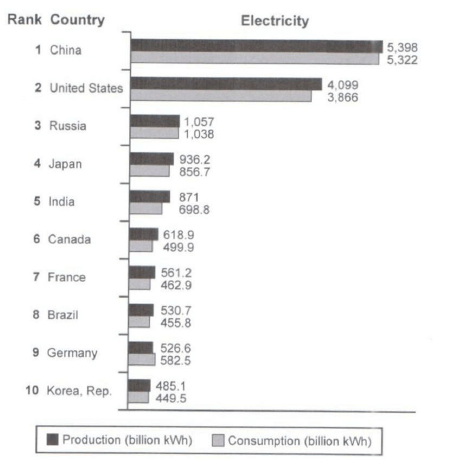
The bar chart below shows the top ten countries for the production and consumption of electricity in 2014.
Summarize the information by selecting and reporting the main features, and make comparisons where relevant.
Student answer (Band 6.0)
The bar chart illustrates the electricity production and consumption of top 10 countries in 2014. The figures are in Billions KWh.
Overall, China and United States were top producers and consumers of the electricity, whereas Korea Republican was the least producer in this category. Every country produces more electricity than its consumption except for Germany whose consumption is little more than its production.
China Production stood at the top with 5398 which is greater than USA with 4099. Russia produces 1057 while japan makes 936.2. India, Canada and france produces 871, 618.9 and 561.7 respectively, Whereas Brazil, Germany and Korea accounted for 530.7, 526.6 and 485.1 respectivly.
China consumption is highest with 5322 compared to USA with 3866 only. Russia and japan had 1038 and 856.7 consumption of electricity. India, Canada and france accounted for 698.8, 499.9 and 462.8 respectively, Whereas Brazil, Germany and Korea had consumption of 455.8, 582.5 and 449.5 only.
AI examiner evaluation
| Criterion | Band |
|---|---|
| Task Achievement / Task Response | 6.0 |
| Coherence and Cohesion | 6.5 |
| Lexical Resource | 6.0 |
| Grammatical Range and Accuracy | 5.5 |
| Overall | 6.0 |
Task Achievement / Task Response: Band 6.0
You cover both production and consumption and provide a clear overview: China and the United States lead, Korea has the lowest production, and Germany is the exception to the general pattern of production exceeding consumption. Most figures are accurately reported, including the leading totals and Germany’s higher consumption. However, some details are slightly inaccurate: France’s production is 561.2, not 561.7, and its consumption is 462.9, not 462.8. The overview could also compare the scale of the leaders with the other countries, and the body mostly lists figures rather than highlighting notable gaps, such as India’s relatively large production-consumption difference. This is relevant and covers the task, though some features are less fully developed.
Coherence and Cohesion: Band 6.5
The response has a clear overall arrangement: an introduction, an overview, then separate paragraphs for production and consumption. This makes the two data sets easy to follow, and linking expressions such as “Overall,” “whereas,” and “respectively” help signal relationships. The progression within each data paragraph is also generally logical, moving from the largest figures to smaller ones. To make the organisation more flexible and cohesive, avoid relying so heavily on lists of countries and numbers; group countries by scale or draw attention to comparisons between the two measures. Capitalisation and punctuation around “Whereas” are inconsistent, and repeated sentence patterns make some connections feel mechanical. The structure is coherent, but cohesion and comparison could be more smoothly integrated.
Lexical Resource: Band 6.0
You use an adequate range of task-related vocabulary, including “illustrates,” “accounted for,” “stood at the top,” and “respectively,” so the data is generally understandable. There are also attempts to vary how figures are presented. However, some word choices and collocations are unnatural or imprecise: “Korea Republican” should be “South Korea” or “the Republic of Korea,” and “least producer” is better expressed as “lowest producer” or “produced the least electricity.” “Makes” is informal for describing electricity output, while “only” after the US consumption figure adds an unnecessary implication. Spelling errors such as “respectivly” also reduce accuracy. More precise, natural reporting phrases would strengthen the description.
Grammatical Range and Accuracy: Band 5.5
You use a mix of simple sentences and some more developed structures, including the contrast in “Every country produces more electricity than its consumption except for Germany…” and the overview clause beginning “whereas.” Meaning is generally clear, but some grammatical errors remain. In “China Production stood at the top,” the noun phrase and capitalisation are not controlled; “China’s production was the highest” would be more accurate. Subject–verb agreement is inconsistent in “India, Canada and france produces,” and the past-tense reporting context is not maintained consistently (“produces,” “makes,” and “had”). Articles and possessives also need attention, as in “the electricity” and “China consumption.” Check sentence punctuation and use consistent past-tense forms to improve control.
See this exact question answered at other band scores. The same prompt compared across bands.
Browse more IELTS Writing model answers or get your own writing scored by the same AI examiner.