Band 5.5 IELTS Writing Task 1 Model Answer
Overall Band Score: 5.5 · Cambridge IELTS 13 · 2026-11-23
IELTS Writing Task 1 question
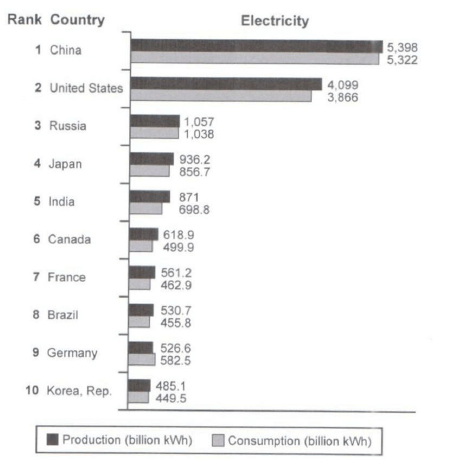
The bar chart below shows the top ten countries for the production and consumption of electricity in 2014.
Summarize the information by selecting and reporting the main features, and make comparisons where relevant.
Student answer (Band 5.5)
The bar chart illustrates the first ten countries who produced and comsumed electricity in 2014.
Overall, China had the highest rank in production and consumption, followed by United States, Russia, Japan, India, Canada, France, Brazil, Germany and Korea with the lowest rank.
The bar chart showed that China had the most rank with production of 5,398 billion (kWh) and consumption of 5,322 (billion kWh) which is the highest . United State has a relatively high rank of 4,099 and 3866 (billion kWh).
Meanwhile, Russia, Japan, India, Canada, France, Brazil and Germany had low ranks of 1,057/1,038, 936.2/856.7, 871/698.8, 618.9/499.9, 561.2/462.9, 530.7/455.8, 526.6/582.5 respectively. Whereas Korea had the lowest rank in both production and consumption with 485.1 for production and 449.5 for consumpt.
AI examiner evaluation
| Criterion | Band |
|---|---|
| Task Achievement / Task Response | 5.0 |
| Coherence and Cohesion | 6.0 |
| Lexical Resource | 5.0 |
| Grammatical Range and Accuracy | 5.5 |
| Overall | 5.5 |
Task Achievement / Task Response: Band 5.0
You identify the chart’s subject and give a clear broad overview: China leads both measures, while Korea is lowest, and you include figures for all ten countries. However, the response only partially develops the main comparisons. The sequence of countries is presented as a ranking, but the key contrast between the two leading countries and the much lower figures for the remaining countries is not explained. The description of the middle group as having “low ranks” is also imprecise, and Germany is a notable exception because consumption (582.5) exceeds production (526.6), unlike the pattern for most countries. The response is 28 words below the required minimum, which limits the detail available. Add a fuller overview and explain the most significant comparisons.
Coherence and Cohesion: Band 6.0
The response has a coherent overall arrangement: an introduction, an overview, and two paragraphs of supporting figures. The progression from the leading countries to the lower-ranked group is easy to follow, and “Overall” and “Meanwhile” help signal the structure. However, cohesion is sometimes mechanical, and the final paragraph becomes a long list of country figures rather than a developed comparison. “Whereas” introduces Korea, but the relationship to the preceding information is not fully clear. You could improve progression by grouping countries by scale, then highlighting exceptions such as Germany, and using linking phrases to explain contrasts rather than simply listing data. This would make the organisation more purposeful while retaining the clear paragraph structure.
Lexical Resource: Band 5.0
Your vocabulary is sufficient to identify the chart’s topic and report its figures, with terms such as “production,” “consumption,” and “highest” used in relevant contexts. However, the range is limited and some word choices are inaccurate or repetitive. “Had the most rank” and “had low ranks” do not naturally describe electricity output; use “produced the most electricity” and “recorded lower figures.” “First ten countries who” is also an awkward description of the chart’s top ten countries. There are spelling or form slips, including “comsumed” and “consumpt,” which reduce precision. Aim for a small range of accurate chart language—such as “stood at,” “was considerably higher than,” and “the figures were broadly similar”—rather than repeating “rank.”
Grammatical Range and Accuracy: Band 5.5
You use a mix of simple statements and some longer structures, including the sentence beginning “Meanwhile” and the clause introduced by “Whereas.” The main information is generally understandable, but grammatical control is uneven. For example, “United State has” has a number and agreement problem, while “which is the highest” is awkwardly attached to the preceding figures and lacks clear reference. The sentence listing seven countries and their values is also difficult to manage, with punctuation and clause boundaries making it cumbersome. There is some effective use of past tense (“had”), but tense and sentence patterns are not consistently controlled. Build accuracy with shorter comparison sentences, check singular and plural forms, and use punctuation to separate each comparison clearly.
See this exact question answered at other band scores. The same prompt compared across bands.
Browse more IELTS Writing model answers or get your own writing scored by the same AI examiner.