Band 5.5 IELTS Writing Task 1 Model Answer
Overall Band Score: 5.5 · Cambridge IELTS 13 · 2026-11-24
IELTS Writing Task 1 question
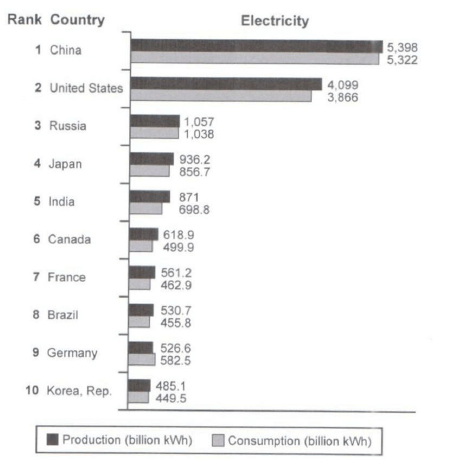
The bar chart below shows the top ten countries for the production and consumption of electricity in 2014.
Summarize the information by selecting and reporting the main features, and make comparisons where relevant.
Student answer (Band 5.5)
The bar chart presents the top productive and consumptive countries of electricity during 2014.
Overall, all countries have almost similair rate of production and consumption. Moreover China have the highest propotion of production and consumption of electricity, while Korea have the least cosumption and production.
The rating of China's consumption and production is significantly high with 5,322kWh and 5.398 respectivly, followed by The United States which also have a high rate of consumption and production with 3.866kWh and 4.099kWh. Then Russia with 1.051kWh of production and 1.038kWh of use. After Japan, India and Canada produce 936.2kWh, 871kWh and 618.9kWh respectivly, and consume( 856.7, 698.8 and499.9)kWh
respectivly.
France and Brazil have almost similair production an consumption rate with around 540kWh and 455kWh respectivly. Gemany is the only country which it's consmption is more than it's prosuction with 582.5kWh.
Finaly korea withe lowest rate of both of consumption and prodution with 485.1kWh and 449.5kWh respectivly.
AI examiner evaluation
| Criterion | Band |
|---|---|
| Task Achievement / Task Response | 6.0 |
| Coherence and Cohesion | 6.0 |
| Lexical Resource | 5.5 |
| Grammatical Range and Accuracy | 5.0 |
| Overall | 5.5 |
Task Achievement / Task Response: Band 6.0
You identify the main overall pattern: China leads both measures by a wide margin, and Korea is among the lowest, while Germany is the exception where consumption exceeds production. You also include comparisons across several countries, so the response addresses the chart. However, some figures are inaccurate or unclear: China’s production is written as “5.398” rather than 5,398, the US figures are reversed in the sentence, and Russia’s production is given as 1,051 instead of 1,057. The overview claim that all countries have “almost similar” rates is too broad, given the large gaps between the leading countries and the rest. A more precise overview and careful reporting of key figures would make the main features clearer and more fully developed.
Coherence and Cohesion: Band 6.0
The response has a clear basic structure: an introduction, an overview, and a sequence of details, with countries generally presented in chart order. Linking expressions such as “Overall,” “Moreover,” “followed by,” and “Finally” help the reader follow the account. However, the country-by-country listing makes the progression somewhat mechanical, and some sentences combine several figures in a way that is difficult to scan, particularly the sentence covering Japan, India, and Canada. The parenthetical consumption figures are also not clearly matched to each country. Grouping the two leading countries, the middle-ranking countries, and the lower figures into separate comparisons, with clearer references, would improve cohesion and make the information easier to follow.
Lexical Resource: Band 5.5
You use relevant chart vocabulary, including “production,” “consumption,” “highest,” “lowest,” and “followed by,” which allows you to describe the data. There is also some attempt at variation through phrases such as “rate” and “use.” However, several word choices and collocations are inaccurate or unnatural: “top productive and consumptive countries” would be better expressed as countries with the highest electricity production and consumption, while “rating” and “proportion” do not accurately describe these quantities. Spelling errors such as “similair,” “propotion,” “respectivly,” and “consumtion” are noticeable. Use precise terms consistently and proofread spelling; this would make the vocabulary more accurate and appropriate for a data report.
Grammatical Range and Accuracy: Band 5.0
You attempt both simple and more extended sentence forms, including comparisons and clauses introduced by “while” and “which.” The overall meaning is usually recoverable, but grammatical control is uneven. Subject–verb agreement errors appear in “China have” and “the United States which also have,” and the phrase “the only country which it’s consumption…” has an unclear relative-clause structure. There are also problems with articles and sentence construction, as in “After Japan, India and Canada produce…,” where the intended comparison is not expressed clearly. Some punctuation and spacing around figures also make sentences harder to read. Practise accurate agreement and build longer comparisons from a clear subject and verb; this will help you use complex structures more reliably.
See this exact question answered at other band scores. The same prompt compared across bands.
Browse more IELTS Writing model answers or get your own writing scored by the same AI examiner.