Band 5.5 IELTS Writing Task 1 Model Answer
Overall Band Score: 5.5 · Cambridge IELTS 13 · 2026-11-25
IELTS Writing Task 1 question
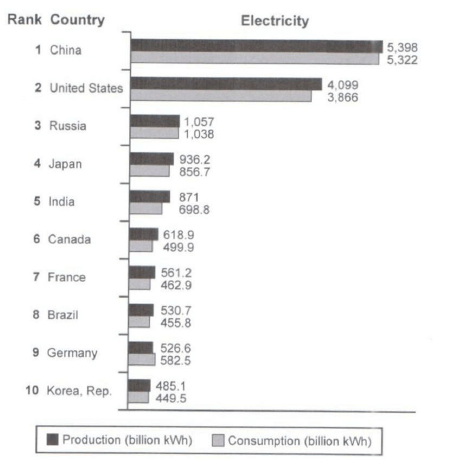
The bar chart below shows the top ten countries for the production and consumption of electricity in 2014.
Summarize the information by selecting and reporting the main features, and make comparisons where relevant.
Student answer (Band 5.5)
The chart comperes the production and consumption of electricity of ten developed countries and it is the report which was done in 2014.
From this figure it is quite clear that China is in the first position in both production and consumption and the amount is 5398 and 5322 repectively. United states stands in the second position for both producing and consuming. Japan and Russia show the similar result in both gneration and comsumption of electricity. And the another countries Like India, Canada, France, Brazil, show alomst similar result. Nevertheless Germany shows the opposite trends that its necessity is higher than its generation. Some countries genetion of electricity is much more higher than consumption like United States, India, Canada. But in Korea Rep. generation and comsumption is almost balanced.
Hence it is clear that eccept Germany every countries has higher electricity genetion capability than its consumption. And Korea Rep. shows the balanced result. At the same time China has the capability of managing its huge demand of electricut
AI examiner evaluation
| Criterion | Band |
|---|---|
| Task Achievement / Task Response | 6.0 |
| Coherence and Cohesion | 5.5 |
| Lexical Resource | 5.0 |
| Grammatical Range and Accuracy | 5.0 |
| Overall | 5.5 |
Task Achievement / Task Response: Band 6.0
You identify the main pattern accurately: China leads both measures, and Germany is the exception where consumption exceeds production. The figures for China are correct, and your comparison of production with consumption gives the response a relevant overview. However, several comparisons are broad or imprecise. For example, Japan and Russia do not show “similar result” in scale, even though production is slightly above consumption in both; the countries’ output levels differ greatly. The claim that the United States, India and Canada have “much more higher” production also overstates the gaps, particularly for the United States. Include a few more accurate figures or comparisons, such as the large gap between China and the other countries and Germany’s consumption of 582.5 billion kWh, to develop the key features more fully.
Coherence and Cohesion: Band 5.5
The response has a recognisable sequence: an introduction, a description of leading countries and comparisons, and a concluding summary. Linking expressions such as “Nevertheless” and “Hence” help signal contrast and conclusion. However, the progression within the main paragraph is not always clear: it moves from Japan and Russia to several other countries, then to Germany and selected production gaps without a consistent grouping. The repeated use of “And” to begin sentences, and the final sentence ending abruptly, weaken the flow. Some references are also vague, such as “the another countries” and “the balanced result.” Group the countries by meaningful patterns—for example, the two leaders, the general production surplus, and Germany’s exception—and use clearer references to make the comparisons easier to follow.
Lexical Resource: Band 5.0
You use relevant topic vocabulary, including “production,” “consumption,” “generation,” “capability,” and “trends,” so the subject is generally understandable. However, the range is limited and several word choices or collocations are inaccurate, which makes parts of the report awkward. “The chart comperes” should be “compares,” while “necessity” is not a suitable substitute for electricity consumption. Phrases such as “similar result,” “balanced result,” and “managing its huge demand” are imprecise for describing the data. Spelling errors—including “repectively,” “gneration,” and “eccept”—are also noticeable. Aim for precise, repeated-use-safe terms such as “output,” “consumption,” “exceeded,” and “the gap between production and consumption,” and check spelling carefully.
Grammatical Range and Accuracy: Band 5.0
You attempt both simple and more complex sentences, including the contrast in “Nevertheless Germany shows the opposite trends that…” and the concluding clause beginning “Hence.” However, grammatical control is uneven, and errors sometimes make relationships between ideas difficult to interpret. For example, “the report which was done in 2014” is an awkward relative-clause construction; “every countries has” has an agreement error; and “the another countries” has an article/determiner problem. The final sentence, “At the same time China has the capability…,” is incomplete, so its intended point is unclear. Practise forming complete sentences with accurate subject–verb agreement and articles, and use straightforward structures to express comparisons before attempting longer clauses.
See this exact question answered at other band scores. The same prompt compared across bands.
Browse more IELTS Writing model answers or get your own writing scored by the same AI examiner.