Band 5.5 IELTS Writing Task 1 Model Answer
Overall Band Score: 5.5 · Cambridge IELTS 13 · 2026-11-26
IELTS Writing Task 1 question
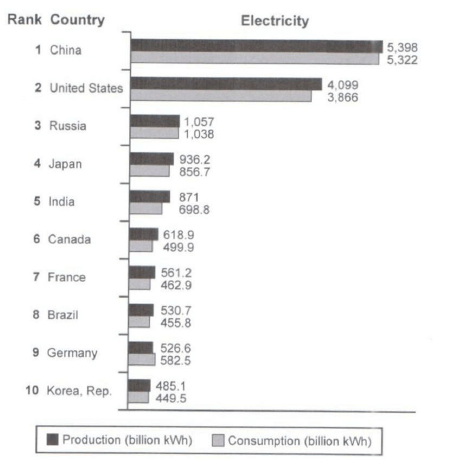
The bar chart below shows the top ten countries for the production and consumption of electricity in 2014.
Summarize the information by selecting and reporting the main features, and make comparisons where relevant.
Student answer (Band 5.5)
The bar chart demonstrates top ten countries of the world that are producing amount of electricity and how much are they consuming in the 2014.
Firstly, China has the top rank in the list where it is producing electricity of 5,398kwh and is consuming 5,322 kwh which equal to amount of electricity produced. Moreover, USA has the second position in the chart and is also consuming the same amount of electricity and it is producing.
Whereas Russia, Japan and India are producing electricity approximately upto 1000 kwh and are consuming at the same rate. Incontrast, Canada, France and Brazil are consuming and producing less electricity as compared to other countries but Germany alone is consuming more electricity then it's production.
Overall, Korea has the 10th rank in the chart and is producing and consuming least amount of electricity than other competitors but most of the countries in the chart are consuming same amount of electricity as the amount they are producing.
AI examiner evaluation
| Criterion | Band |
|---|---|
| Task Achievement / Task Response | 5.5 |
| Coherence and Cohesion | 6.0 |
| Lexical Resource | 5.5 |
| Grammatical Range and Accuracy | 5.5 |
| Overall | 5.5 |
Task Achievement / Task Response: Band 5.5
You identify the chart’s subject and report several relevant comparisons, including China’s leading position, Korea’s lowest ranking, and Germany as the exception where consumption exceeds production. However, some key details are inaccurate or too general. The United States does not consume the same amount it produces: the figures are 3,866 and 4,099 billion kWh. Russia, Japan and India are not all producing approximately 1,000 billion kWh, and their consumption is not at the same rate; India’s consumption is notably lower. The overview that most countries consume the same amount as they produce therefore overstates the similarity. To strengthen the response, give a more accurate overview of the large gap between the top two countries and the much lower figures elsewhere, and support comparisons with selected figures.
Coherence and Cohesion: Band 6.0
The response has a generally understandable order: it introduces the chart, discusses the leading countries, groups several middle-ranking countries, and ends with Korea and a broad summary. Connectors such as “Moreover,” “Whereas,” and “Overall” help signal these moves. However, the progression is not always clear because the final overview repeats an earlier point, and “Whereas” does not connect smoothly to the preceding sentence. The grouping of Russia, Japan and India also combines figures that differ substantially, making the comparison less coherent. Use distinct paragraphs for the overview and supporting details, and organise the body around clear comparisons—for example, the two leading producers, then the remaining countries and Germany’s exception. Ensure each linking word accurately expresses the relationship between ideas.
Lexical Resource: Band 5.5
You use relevant vocabulary for describing charts, including “top rank,” “second position,” “producing,” “consuming,” and “amount.” This makes the topic clear, but the range is limited and some expressions are imprecise or repetitive. “Same amount of electricity” is used for countries whose production and consumption figures are not equal, while “competitors” is not a natural description of countries in this chart. There are also spelling and form issues, such as “Incontrast” and “upto,” which reduce accuracy. Aim for more precise chart language and vary repeated terms: describe figures as “output” and “consumption,” and use “higher than” or “lower than” when comparing values. Check standard spelling and spacing in phrases before finishing.
Grammatical Range and Accuracy: Band 5.5
You attempt a mixture of simple and more complex sentences, including clauses beginning with “where” and “whereas,” and the main message is generally understandable. However, some errors in sentence structure and grammatical forms remain. For example, “how much are they consuming” uses question word order inside a statement; “which equal to amount” is missing a verb and article; and “it is producing” does not agree clearly with the plural subject “USA” as used in the sentence. The opening also has an awkward construction: “countries … that are producing amount.” Practise accurate statement word order and complete clause structures, such as “how much electricity they consumed” and “which was almost equal to its production.” Review articles, agreement and punctuation when combining clauses.
See this exact question answered at other band scores. The same prompt compared across bands.
Browse more IELTS Writing model answers or get your own writing scored by the same AI examiner.