Band 5.5 IELTS Writing Task 1 Model Answer
Overall Band Score: 5.5 · Cambridge IELTS 13 · 2026-11-27
IELTS Writing Task 1 question
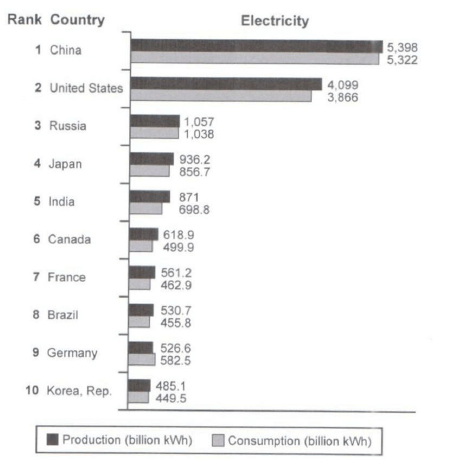
The bar chart below shows the top ten countries for the production and consumption of electricity in 2014.
Summarize the information by selecting and reporting the main features, and make comparisons where relevant.
Student answer (Band 5.5)
The bar chart illustrates the highest range of countries for the production and comsumption of the eletricity in 2014.
Overall, the highest percentage of eletricity was recorded in the China but the lowest consumption and production of power was found in the Korea in 2014.
To start with, the maximum power of eletricity was used in China which was 5322 billoin kwh and production of power produced upto 5398 billion.Moreover, 4099 billion kwh eletricity was produced in the United states or 3866 bilion kwh they consumed in 2014. Whereas,there was bleak difference in the production and consumption of power found in the third rank of the country. Futhermore, in fourth country the production and consumption has also mimimum difference of 100 approximately even India has a difference of 200 between their consumption and production.
Moving further, in Canada the consumption and production of eletricity was 618.9 and 499.9 in 2014. Apart from this France has a lowest usage of eletricity between them. Eventually, Brazil and Germany also has a minimum difference in production and consumed of eletricity.
AI examiner evaluation
| Criterion | Band |
|---|---|
| Task Achievement / Task Response | 5.5 |
| Coherence and Cohesion | 5.5 |
| Lexical Resource | 5.0 |
| Grammatical Range and Accuracy | 5.0 |
| Overall | 5.5 |
Task Achievement / Task Response: Band 5.5
You identify the chart’s subject and give a relevant overview: China leads in both measures, while Korea is among the lowest. You also include several accurate figures, such as China’s production and consumption and the United States’ totals. However, the overview is incomplete and partly inaccurate: Korea has the lowest production, but Germany—not Korea—has the lowest consumption among the listed countries? In fact, Korea’s consumption is lowest, so your statement is correct. More importantly, the comparison that France has the lowest usage is inaccurate; Korea is lower. Several key comparisons are vague or missing, and the Germany exception, where consumption exceeds production, is not explained. Develop the main patterns more clearly and report selected figures accurately.
Coherence and Cohesion: Band 5.5
The response has a basic structure, with an introduction, an overview, and two body sections. Sequencing phrases such as “To start with” and “Moving further” help signal movement through the data. However, progression is not consistently clear: the first body paragraph moves from China and the United States to Russia, Japan, and India without giving the figures needed to make those comparisons meaningful. Some linking is mechanical or awkward, particularly “Whereas” after a full sentence and “Apart from this” before the France point. Group countries by meaningful patterns—for example, the two leading producers and the smaller-output countries—and use clear references so each comparison is easy to follow.
Lexical Resource: Band 5.0
You use some task-relevant terms, including “production,” “consumption,” “difference,” and “recorded,” so the topic is generally understandable. However, the vocabulary range is limited and several choices are inaccurate or unnatural, such as “highest range of countries,” “maximum power of electricity,” and “lowest usage of electricity between them.” Repetition of “power” and “electricity” also makes the description less precise. There are noticeable spelling errors, including “comsumption,” “eletricity,” “billoin,” and “Futhermore,” which reduce the overall control of written vocabulary. Aim for standard chart language and check spelling carefully; precise terms such as “output,” “consumed,” and “respectively” would help you describe the data more efficiently.
Grammatical Range and Accuracy: Band 5.0
You attempt both simple and more complex sentence forms, including a relative clause in “which was 5322” and a contrast introduced by “Whereas.” However, complex constructions are often faulty, and errors occur frequently enough to make some sentences difficult to read. For example, “4099 billion kwh electricity was produced … or 3866 … they consumed” lacks a clear grammatical connection between the two figures, while “the production and consumption has” has a subject–verb agreement error. Articles and sentence boundaries are also inconsistent, as in “in the China” and “Whereas,there.” Work on forming complete comparisons, matching verbs to plural subjects, and punctuating clauses correctly. More accurate simple sentences would improve clarity before you add complexity.
See this exact question answered at other band scores. The same prompt compared across bands.
Browse more IELTS Writing model answers or get your own writing scored by the same AI examiner.