Band 6.0 IELTS Writing Task 1 Model Answer
Overall Band Score: 6.0 · Cambridge IELTS 13 · 2026-11-27
IELTS Writing Task 1 question
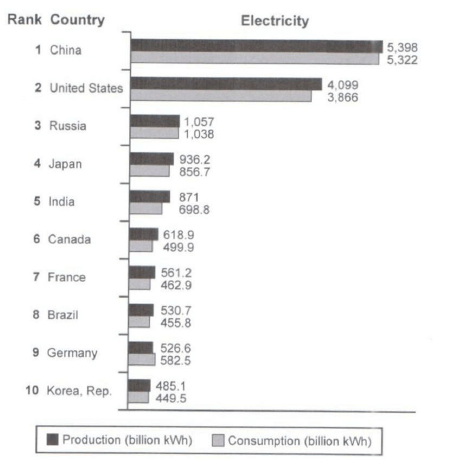
The bar chart below shows the top ten countries for the production and consumption of electricity in 2014.
Summarize the information by selecting and reporting the main features, and make comparisons where relevant.
Student answer (Band 6.0)
The bar chart illustrates the amount of electricity being produced and used in the top ten countries: China, The United States, Russia, Japan, India, Canada, France, Brazil, Germany and Korea in 2014. Units are measured in billion kWh.
Overall, in every country the production rate of electricity was higher than the consumption, except Germany. However, Chine was the country that produced greatest proportion of electricity and consumed the most, whereas Korea have developed the least amount of electricity, so used lowest quantity.
In 2014, China have made 5.398 billion kWh electricity and consumed 5,322 billion kWh electricity. The United States produced 4,099 billion kWh current and utilized 3,866 billion kWh.
Conversely, Russia, Japan and India were really close in terms of the electric production and consumption. Russia, Japan and India made 1,057 billion kWh, 936.2 billion kWh and 871 billion kWh current and used 1,038 billion kWh, 856.7 billion kWh and 6,98.8 billion kWh electricity, respectively.
In Germany the production rate was only 526.6 billion kWh, while utilized 582.5 billion kWh. Korea have produced only 485.1 billion kWh and consumed 449.5 billion kWh current.
AI examiner evaluation
| Criterion | Band |
|---|---|
| Task Achievement / Task Response | 6.0 |
| Coherence and Cohesion | 6.5 |
| Lexical Resource | 6.0 |
| Grammatical Range and Accuracy | 5.5 |
| Overall | 6.0 |
Task Achievement / Task Response: Band 6.0
You provide a relevant overview, identifying China as the largest producer and consumer and Germany as the exception to the general pattern of production exceeding consumption. Several figures are reported accurately, including those for China, the United States, Russia, Japan, and Germany. However, the overview says Korea produced and consumed the least, which is not fully accurate: Korea had the lowest production, but Germany’s consumption was higher than its production and Korea’s consumption was lower than Germany’s but not the lowest overall? In fact, Korea’s 449.5 is the lowest consumption among the listed countries. Some comparisons are under-developed: the statement that Russia, Japan, and India were “really close” is vague, and the lower-ranked countries receive little comparative detail. Select key contrasts and describe them more precisely to make the summary more complete and clear.
Coherence and Cohesion: Band 6.5
The response has a clear overall structure: an introduction, an overview, and two paragraphs presenting figures. The progression from the two leading countries to the middle and lower ranks is generally easy to follow, and linking expressions such as “Overall” and “Conversely” help signal relationships. This meets the lower-band expectation of coherent organisation and shows some effective progression. However, “Conversely” does not clearly introduce the Russia–Japan–India comparison, since it signals contrast without specifying what is being contrasted. The final paragraph also combines Germany and Korea without explaining their relationship to the other countries. Use more precise transitions and organise comparisons into meaningful groups, such as the two leaders, the middle group, and the lower-ranked countries.
Lexical Resource: Band 6.0
You use an adequate range of task-related vocabulary, including “produced,” “consumed,” “utilized,” “production rate,” and “respectively,” so the main information is generally understandable. There are also attempts to vary wording rather than repeat the same verb throughout. However, some choices are inaccurate or unnatural for describing chart data: “current” is used instead of “electricity,” “made” is less suitable than “generated,” and “developed the least amount of electricity” does not express production clearly. “Really close” is also informal and imprecise. The spelling “Chine” and the inconsistent number formatting weaken accuracy. Aim for standard collocations such as “generated electricity” and “consumption stood at,” and check country names and figures carefully.
Grammatical Range and Accuracy: Band 5.5
You attempt both simple and more complex sentence forms, including a contrast clause with “whereas” and a relative clause in “the country that produced greatest proportion.” Most sentences remain understandable, and the figures are usually presented in recognisable sentence patterns. However, some errors in verb forms and agreement recur: “China have made,” “Korea have developed,” and “Korea have produced” should use singular past-tense forms. The phrase “produced greatest proportion” also needs an article, and “while utilized 582.5” lacks a clear subject. These errors do not generally prevent understanding, but they limit grammatical control. Practise consistent past-tense reporting and ensure each clause has a complete subject and verb; vary sentence structures while keeping them accurate.
See this exact question answered at other band scores. The same prompt compared across bands.
Browse more IELTS Writing model answers or get your own writing scored by the same AI examiner.