Band 5.5 IELTS Writing Task 1 Model Answer
Overall Band Score: 5.5 · Cambridge IELTS 13 · 2026-11-28
IELTS Writing Task 1 question
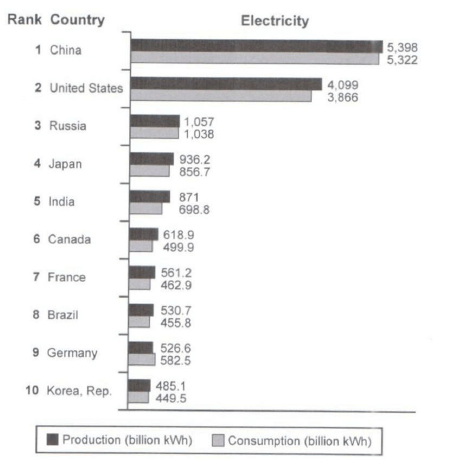
The bar chart below shows the top ten countries for the production and consumption of electricity in 2014.
Summarize the information by selecting and reporting the main features, and make comparisons where relevant.
Student answer (Band 5.5)
The given column graph illustrates the top ten countries and consumption of electricity in the year 2014. The countries that are mentioned in the graph are China, the United States, the Russia, Japan, India, Canada, France, Brazil, Germany and Korea.
In China, the production and consumption of electricity has touched the sky. The following chart depicted China on the top position, with 5398 production and 5322 consumption rate. Thereafter, the United States has been marked second with 4099 and 3866, production and consumption rate respectively. In countries like Russia and Korea, production has been done as same as consumption. Whereas Germany is the only country whose consumption is more than the production rate. Their production is 526.6 billion kWh and consumption is 582.5 billion kWh.
Overall, China has been ranked on the top position as it is the only country whose consumption and production both are vey high. Whereas Korea has consumed and produced very low
electricity because of having the least population therefore marked the last.
AI examiner evaluation
| Criterion | Band |
|---|---|
| Task Achievement / Task Response | 5.5 |
| Coherence and Cohesion | 5.5 |
| Lexical Resource | 5.5 |
| Grammatical Range and Accuracy | 5.5 |
| Overall | 5.5 |
Task Achievement / Task Response: Band 5.5
You identify the leading countries and include several accurate figures, especially China and the United States, and you correctly note that Germany is the only country where consumption exceeds production. However, the response covers the chart only partially: most of the middle-ranked countries are not compared, and the claim that Russia and Korea have production “as same as” consumption is inaccurate, since their production is slightly higher. The overview also adds an unsupported explanation that Korea’s low figures are due to its population. To strengthen the report, summarise the broad pattern across the ten countries and compare key differences, such as the sharp gap between the top two and the remaining countries, without introducing causes the chart does not show.
Coherence and Cohesion: Band 5.5
The response has a basic structure, moving from an introduction to selected details and then an overall statement. Some linking expressions, including “Thereafter” and “Whereas,” help connect points. However, the progression is not fully clear: the overview appears at the end, and the discussion jumps from the two largest producers to Russia, Korea and Germany without a consistent comparison pattern. “Whereas” is also used in a fragment-like construction, and “In countries like Russia and Korea” groups countries whose figures are not actually equal. Organise the body by ranking or by notable comparisons, and place a concise overview before the details. Clearer referencing would also help readers follow which figures belong to each country.
Lexical Resource: Band 5.5
You use some relevant chart vocabulary, such as “production,” “consumption,” “ranked,” and “billion kWh,” so the main subject is generally clear. However, several expressions are unnatural or imprecise for an academic data report: “has touched the sky,” “consumption rate,” “top position,” and “marked the last.” “Very high” and “very low” are also vague when the chart provides measurable values. The phrase “because of having the least population” introduces an unsupported explanation as well as awkward wording. Aim for neutral, precise language such as “recorded the highest output” and “ranked tenth,” and use comparisons like “substantially higher” only where the figures support them.
Grammatical Range and Accuracy: Band 5.5
You attempt a mixture of simple and more complex sentences, including a relative clause in “whose consumption is more than the production rate” and a comparison introduced by “Whereas.” However, control is uneven. The opening says “the top ten countries and consumption,” omitting the parallel idea of production, while “the Russia” uses an unnecessary article. “In countries like Russia and Korea, production has been done as same as consumption” has an awkward passive construction and faulty comparison, and the following “Whereas Germany…” is not a complete independent sentence. There are also tense and agreement inconsistencies, such as “has touched” and “chart depicted.” Use straightforward present-tense reporting structures and check that each sentence is complete and comparisons are grammatically formed.
See this exact question answered at other band scores. The same prompt compared across bands.
Browse more IELTS Writing model answers or get your own writing scored by the same AI examiner.